
The stock market is a regulated marketplace where buyers and sellers trade shares (small units of ownership) of publicly listed companies. In India, this trading happens online on stock exchanges like the National Stock Exchange (NSE) and the Bombay Stock Exchange (BSE). The Securities and Exchange Board of India (SEBI) supervises these exchanges.
Key Takeaways
- Purchasing a share means you own a small fraction of that company.This entitles you to participate in the company’s growth and financial success through rising stock prices or regular dividend payouts.
- Companies raise money for the first time in the primary market (through IPOs). Investors then buy and sell existing shares with each other in the secondary market.
- India has two main national stock exchanges: BSE (tracked by the SENSEX) and NSE (tracked by the NIFTY 50).
- You need three linked accounts to invest: a Bank Account, a Trading Account (with a broker), and a Demat Account (with NSDL or CDSL).
- SEBI regulates the Indian stock market to enforce fair rules and protect investors. However, share prices can still go up or down.
Understanding the Stock Market: A Plain-Language Guide for Beginners
Think of the stock market like a well-organized digital mandi. Rather than purchasing everyday groceries like fruits or vegetables, participants buy and sell small fractional shares of businesses.
Suppose you run a successful bakery chain in Pune. You want ₹50 crore to open 20 new outlets across India. Instead of taking a high-interest bank loan, you can divide your company into lakhs of small parts called shares (or stocks) and sell them to the public.
When someone buys your shares, they become a part-owner (shareholder) of your bakery. If the bakery grows and earns strong profits, more people will want to buy its shares. This demand pushes the share price up. If the business underperforms or faces financial trouble, the value of its shares can drop.
The system of exchanges, brokers, and rules that keeps this buying and selling safe is called the stock market.
A share represents an individual unit of ownership in a business. For example, if a company has issued 1,00,000 shares in total and you buy 1,000 of them, you own 1% of that company.
As a shareholder, you can earn returns in two primary ways:
- Capital Appreciation: This means selling your shares later at a higher price than you paid. For example, you might buy a share at ₹200 and sell it at ₹280.
- Dividends: This is a portion of the company’s profits paid to shareholders in cash, if the company’s board decides to declare one.
In everyday Indian conversation, people use “stock market” and “share market” to mean the same thing. Technically, there is a small difference in what they cover, though both refer to the same system.
How the Indian Stock Market Works: A Step-by-Step Overview
According to the SEBI Investor Portal, the Indian securities market works in two connected stages: the Primary Market and the Secondary Market.
When a company offers its shares to the public for the first time, it can enter the primary market through an Initial Public Offering (IPO). This allows the company to raise capital from investors.
Company Files Documents
The company prepares and files offer documents, such as a Draft Red Herring Prospectus (DRHP) and Red Herring Prospectus (RHP), as applicable, with SEBI.
Investors Apply
Investors submit applications within the announced price band, such as ₹140–₹150 per share in a book-built IPO.
Shares Are Allotted
After the bidding process, shares are allotted according to the IPO rules and applicable category-wise allocation process.
Company Receives Funds
In a fresh issue, the company receives the proceeds and may use them for expansion, business operations, or debt repayment, as disclosed in its offer documents.
Money from a fresh issue goes to the company.
Secondary Market (Where Investors Trade)
After an IPO, the company’s shares may be listed on stock exchanges such as the NSE and BSE. Investors can then buy and sell these shares in the secondary market.
Investor Places an Order
You place a buy or sell order through your stockbroker’s trading app.
Exchange Matches Orders
The exchange’s electronic trading system matches compatible buy and sell orders based on price and order priority.
Trade Is Executed
When a buyer and seller agree at a matching price, the transaction is completed through the exchange system.
Shares Change Hands
The buyer receives the shares through the settlement process, while the seller receives the sale proceeds, after applicable charges.
Investors trade with one another.
What Is a Stock Exchange? How NSE and BSE Work
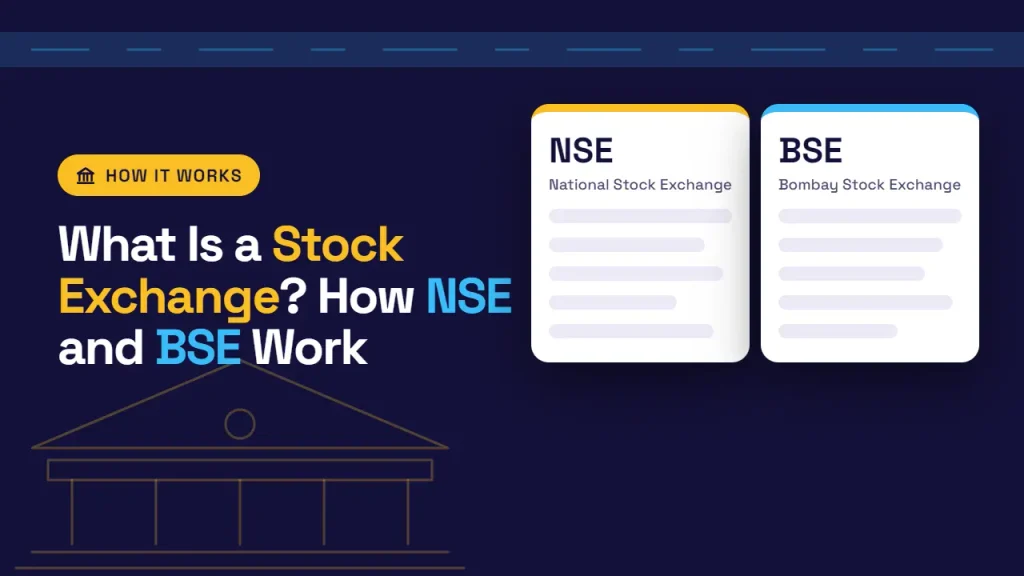
A stock exchange is the regulated platform where secondary market trading takes place. Think of it as a digital system that matches buyers and sellers transparently in fractions of a second.
India’s stock trading is led by two major national exchanges (SEBI Investor):
| Feature | BSE (Bombay Stock Exchange) | NSE (National Stock Exchange) |
|---|---|---|
| Established | 1875 (Asia’s oldest stock exchange) | 1992 (started electronic trading in 1994) |
| Headquarters | Dalal Street, Mumbai | Bandra-Kurla Complex, Mumbai |
| Benchmark Index | S&P BSE SENSEX (tracks 30 major companies) | NIFTY 50 (tracks 50 major companies) |
| Trading System | Fully electronic | Fully electronic (started screen-based trading in India) |
Note: Many large Indian companies are listed on both the NSE and BSE. This means you can easily buy or sell their shares on either exchange using your stockbroker.
Indian Stock Market Timings
Both the NSE and BSE follow the same weekday schedule (Monday to Friday, excluding exchange holidays):
- Pre-Open Session: 9:00 AM to 9:15 AM IST (used to decide the opening price for the day)
- Normal Trading Session: 9:15 AM to 3:30 PM IST (continuous buying and selling)
Note: NSE’s market timings also include post-close and closing auction windows for eligible stocks. Always check the official exchange schedule for exact segment cutoffs.
What Accounts Do You Need to Start Investing in India?
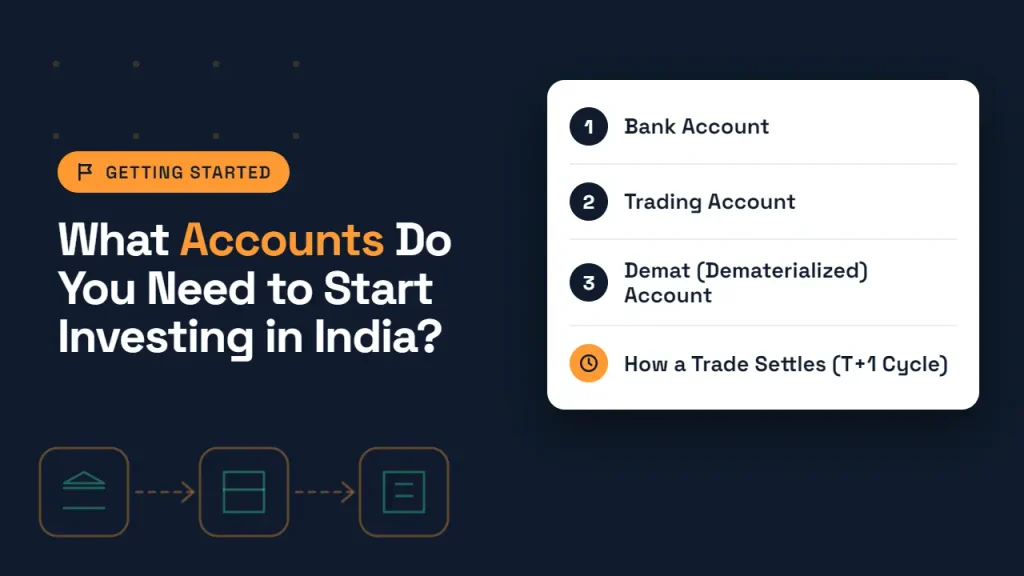
You cannot walk up to the NSE or BSE directly to buy a share. As explained in SEBI’s Start Investing guide, Indian retail investors need a 3-part account setup:
- Bank Account: Holds your Indian Rupees (₹) and moves money to and from your trading account using UPI or net banking.
- Trading Account: Opened with a SEBI-registered stockbroker (such as Zerodha, Groww, Angel One, or ICICI Direct). You use this app or website to place buy and sell orders on the exchange.
- Demat (Dematerialized) Account: Works like a digital locker that stores your shares in electronic form. In India, two central depositories—NSDL and CDSL—maintain Demat accounts. You access them through your broker, who acts as a Depository Participant (an authorized agent).
How a Trade Settles (T+1 Cycle)
When you buy a share today (called Trade Day, or T), the shares move into your Demat account and the money goes to the seller on the next working business day (T+1), as per NSE Clearing’s settlement cycle. India has also started an optional same-day (T+0) settlement pilot for select stocks.
Who Regulates the Indian Stock Market?
The Securities and Exchange Board of India (SEBI) is the regulatory authority that oversees and regulates the Indian stock market. It was set up under the SEBI Act, 1992 (SEBI FAQ).
SEBI acts like a market referee to:
- Protect everyday investors from fraud, insider trading, and price manipulation.
- Enforce transparency by requiring listed companies to publish financial results every quarter.
- Register and monitor stockbrokers, mutual funds, depositories, and exchanges.
- Resolve investor complaints through the official SCORES (SEBI Complaints Redress System) portal if a broker or depository participant does not fix an issue within set timelines (SEBI Depositories Guide).
What Causes Stock Prices to Rise and Fall?
During market hours, a stock’s price moves every second based on supply and demand:
- Higher buying demand drives the share price up.
- More sellers than buyers pushes the price down.
Several real-world factors drive these buying and selling decisions:
- Company Earnings: Strong quarterly profits or new business wins usually attract buyers. Weak results or losses often lead to selling.
- Economic and RBI Policies: Changes in Reserve Bank of India (RBI) interest rates, inflation data, or Union Budget announcements affect borrowing costs and how much people spend.
- Global Events: Crude oil prices, US Federal Reserve rate decisions, and global news often influence Foreign Institutional Investors (FIIs)—large overseas funds—active in India.
- Market Sentiment: News, rumors, or excitement about a whole sector can cause short-term price swings, even when a company’s actual business has not changed.
What Are the Key Risks of Investing in the Stock Market?
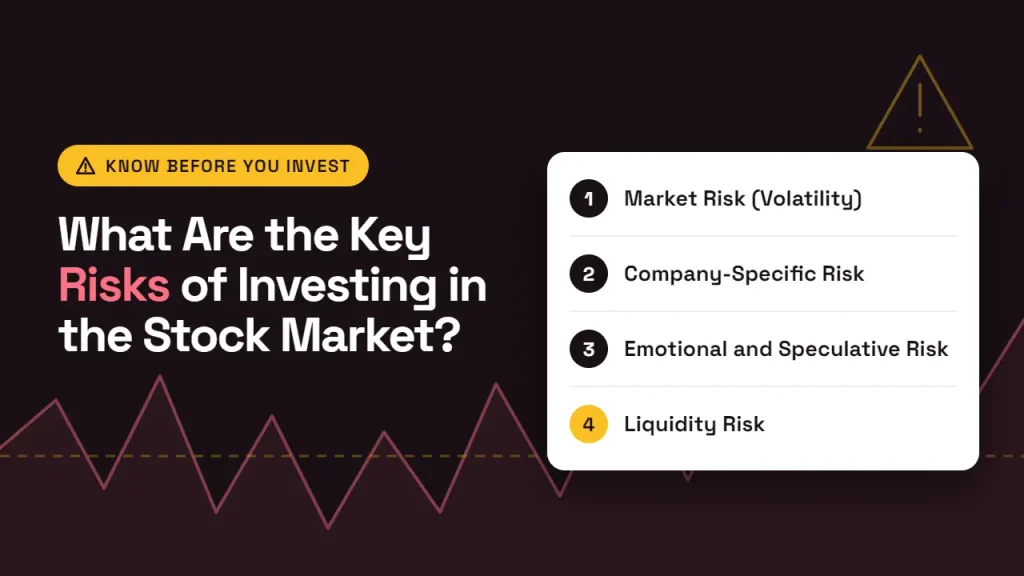
Stocks have historically helped investors beat inflation over long periods. However, the stock market does not offer guaranteed returns like a bank Fixed Deposit (FD). Key risks include:
- Market Risk (Volatility): Even strong companies can see their share prices drop 20%–30% during an economic slowdown or global crisis.
- Company-Specific Risk: Poor management, rising debt, or major changes in an industry can permanently hurt a single company’s value.
- Emotional and Speculative Risk: Buying stocks based on WhatsApp tips or social media hype often leads to losses. The same happens when beginners try high-risk intraday trading or F&O (Futures & Options) without understanding leverage (trading with borrowed money).
- Liquidity Risk: Smaller, lesser-known companies may have very few buyers when you want to sell your shares.
Practical rule for beginners: Never invest your emergency fund or money you will need within the next 1–3 years in the stock market.
Final Takeaway
The stock market is a transparent, SEBI-regulated system that connects growing Indian businesses with everyday investors. When you understand primary and secondary markets, how NSE and BSE work, and why you need a Demat account, you can invest with clarity instead of guesswork.
If you are ready for the next step, learn how to check a company’s financial health or compare buying individual stocks with index mutual funds before placing your first ₹ order.
Frequently Asked Questions (FAQs)
1. What is the minimum amount needed to invest in the Indian stock market?
SEBI does not set any fixed minimum amount to start investing in the Indian stock market. You can buy as little as 1 share of a company. Depending on the company’s share price, this could cost anywhere from ₹50 to several thousand rupees.
2. Can I lose more money than I invest in stocks?
If you buy regular shares for delivery (holding them in your Demat account without borrowing money), the most you can lose is 100% of the money you invested. However, if you trade using margin (borrowed funds) or in Futures & Options (F&O), your losses can be larger than your starting amount.
3. Is the stock market safe in India?
The Indian stock market system is closely regulated by SEBI, and your shares stay safe in electronic form with CDSL or NSDL. Even if your stockbroker shuts down, your shares remain in your Demat account. However, the value of your investments depends on market risk and is never guaranteed.
Yes, in most cases. If a company is listed on both exchanges, shares bought on the NSE are stored in your Demat account and can usually be sold on the BSE (and vice versa). This works because both depositories (NSDL and CDSL) are connected to both exchanges.
5. What is the difference between Sensex and Nifty 50?
Both are benchmark indices—scorecards that measure the overall health of the Indian stock market. The S&P BSE SENSEX tracks 30 large, well-established companies listed on the BSE. The NIFTY 50 tracks 50 major companies listed on the NSE across key sectors of the economy.
Read This Also: