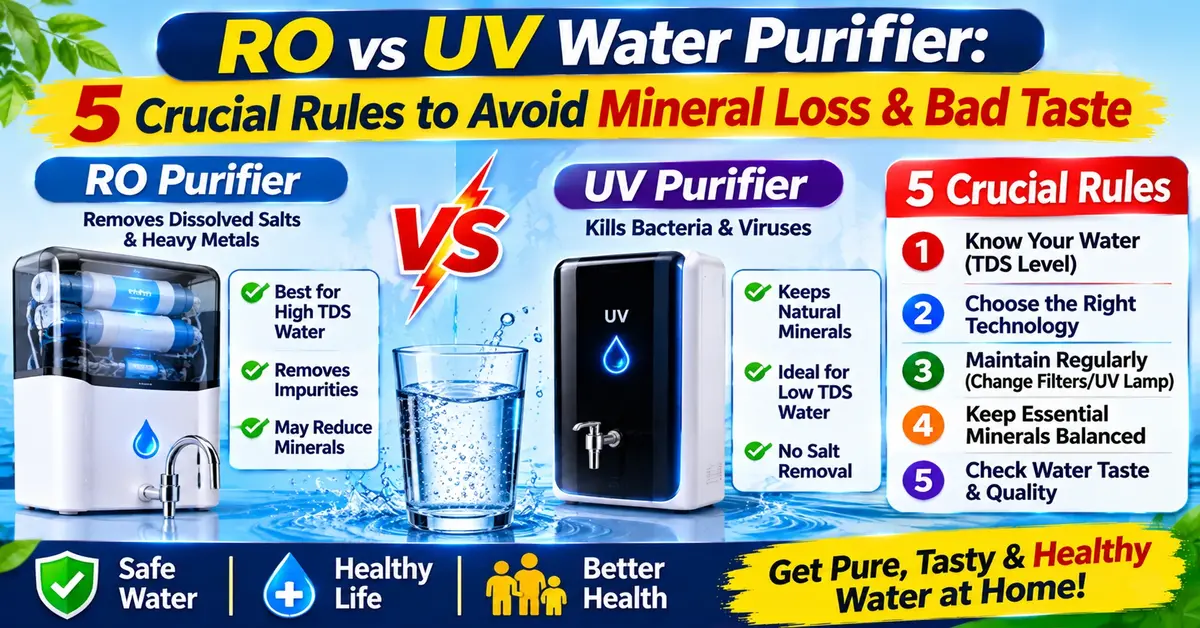
RO vs UV: An RO (Reverse Osmosis) purifier filters out dissolved salts, heavy metals, and high TDS, making it necessary for borewell, tanker, or hard water with TDS levels above 500 mg/L. A UV (Ultraviolet) purifier, on the other hand, disinfects water by eliminating bacteria and viruses without altering the TDS count or removing dissolved solids, making it ideal for low-TDS municipal tap supply.
Key Takeaways
- Match the purifier to your water source: Pick an RO purifier for borewell or tanker water with high TDS. Choose a UV (or UV+UF) purifier for clean, low-TDS municipal tap water.
- Know the BIS standard: Under BIS IS 10500:2012, the acceptable TDS limit for drinking water in India is 500 mg/L (ppm). A higher limit of 2,000 mg/L is allowed only when no other water source is available.
- UV does not lower TDS: A UV purifier kills germs, but it cannot remove dissolved salts, fluoride, or arsenic.
- RO blocks germs too, but needs care: An RO membrane physically blocks bacteria and viruses. Still, many Indian models add a UV or UF stage as an extra safety step.
- Budget for yearly upkeep, not just the MRP: In India, RO systems usually cost ₹3,000–₹6,000 a year to maintain. UV purifiers cost about ₹1,500–₹3,000 a year (Bajaj Finserv).
Introduction
Buying a water purifier in an Indian electronics store or online can feel confusing. Almost every box lists a mix of terms like RO, UV, UF, TDS Controller, Alkaline, and Copper. Prices also vary widely, from ₹6,000 to over ₹25,000.
Indian cities and towns get water from very different sources, such as river-fed municipal taps, deep borewells, and private water tankers. Choosing the wrong purifier wastes both your money and water. This guide explains the real difference between RO and UV water purifiers using Indian drinking water standards, real upkeep costs, and simple rules for your home.
Difference Between RO and UV Water Purifiers
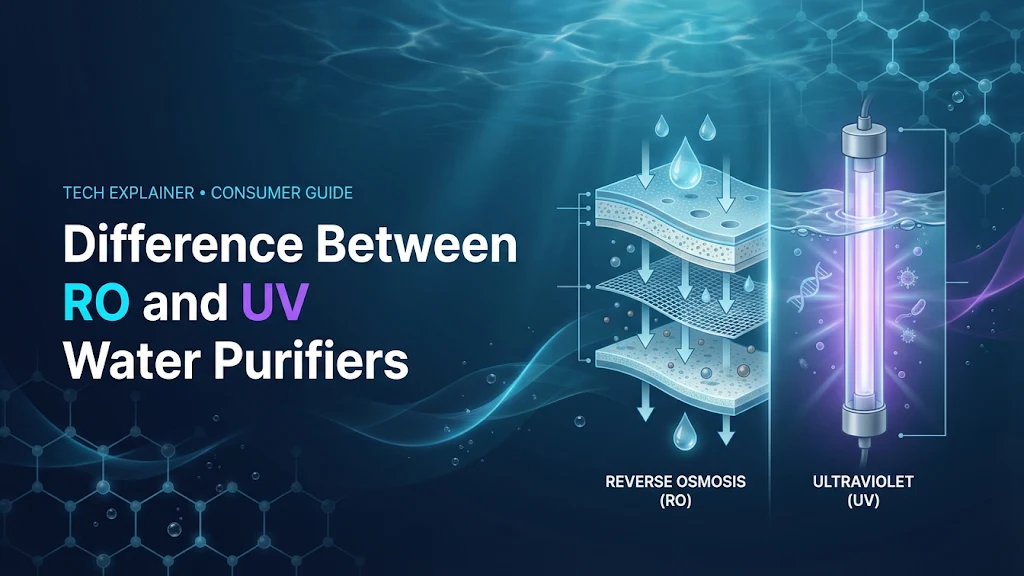
In simple terms, an RO purifier works like an ultra-fine strainer under high pressure. A UV purifier works like a light chamber that disables germs.
| Feature | RO (Reverse Osmosis) Purifier | UV (Ultraviolet) Purifier |
|---|---|---|
| Main Job | Removes dissolved salts, heavy metals, and lowers TDS | Kills bacteria, viruses, and protozoa |
| Lowers TDS? | Yes (usually by 90%–99% across the membrane) | No (TDS stays the same) |
| Removes Dissolved Salts & Heavy Metals? | Yes (fluoride, arsenic, lead, nitrates, hardness salts) | No |
| Kills Bacteria & Viruses? | Yes (blocks germs physically; often paired with UV) | Yes (damages germ DNA so they cannot multiply) |
| Water Wastage | Yes (produces reject water) | No (zero reject water) |
| Needs Electricity? | Yes (runs a booster pump) | Yes (powers the UV lamp) |
| Best Water Source | Borewell, tanker, or hard water (>500 mg/L TDS) | Low-TDS municipal/corporation tap water (<300–500 mg/L) |
| Approx. Yearly Maintenance | ₹3,000 – ₹6,000 (Bajaj Finserv) | ₹1,500 – ₹3,000 (Bajaj Finserv) |
How RO and UV Purifiers Work
How an RO Water Purifier Works
An RO purifier uses pressure and a semi-permeable membrane to reduce dissolved impurities in water.
Pre-filtration
Water passes through a sediment filter that traps particles such as mud, sand, and rust. An activated carbon filter may then reduce chlorine, odour, and certain organic compounds.
High-pressure Pumping
An electric pump creates the pressure needed to push water through the semi-permeable RO membrane, which has extremely small pores.
Separation
The membrane allows water to pass through while rejecting a large proportion of dissolved salts and other contaminants. The concentrated reject water flows out through a separate drain line.
Post-treatment
Filtered water may pass through additional carbon, mineraliser, or TDS-control stages before entering the storage tank. The exact setup varies by purifier model.
How a UV Water Purifier Works
A UV purifier uses ultraviolet light to inactivate microorganisms in water rather than removing dissolved salts.
Pre-filtration
Water may pass through sediment and activated carbon filters to reduce suspended particles, chlorine, and unwanted odours before UV treatment.
UV Chamber Exposure
Water flows through a treatment chamber containing a UV-C lamp, usually protected by a quartz sleeve that allows ultraviolet light to reach the water.
Disinfection
UV-C light damages the genetic material of susceptible microorganisms, preventing them from reproducing. Properly designed systems can inactivate bacteria, viruses, and other pathogens.
Direct Output
Treated water moves towards the outlet or storage tank. UV treatment itself does not remove dissolved salts or add reject-water discharge, and it generally leaves dissolved minerals unchanged.
RO physically separates many dissolved impurities from water and produces a reject-water stream. UV disinfects water by inactivating microorganisms but does not reduce TDS or remove dissolved salts. Some purifiers combine both technologies for broader treatment.
TDS Limit for Drinking Water in India (BIS & WHO Standards)
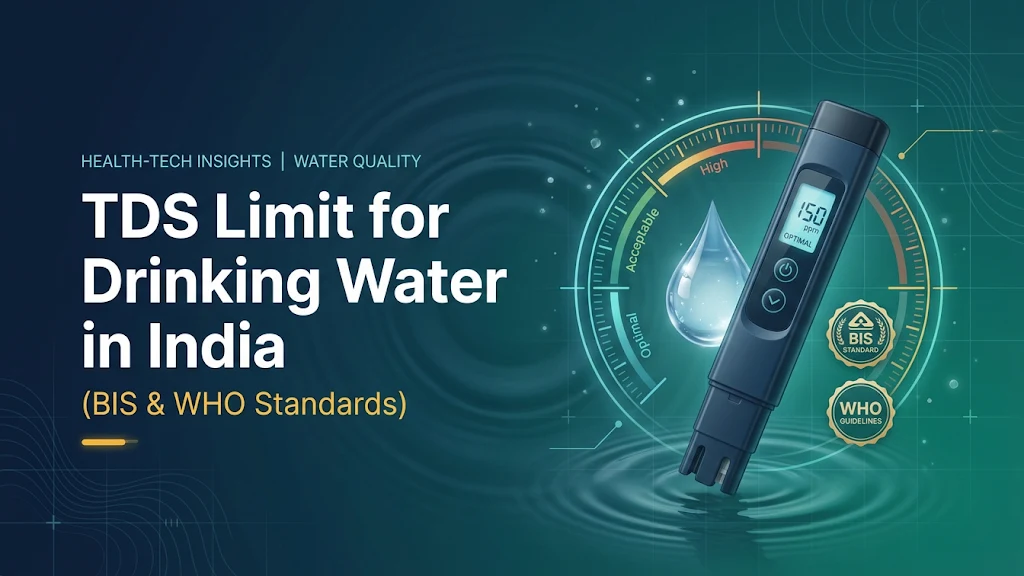
Before buying a purifier, test your tap water with a digital TDS meter (available online for about ₹200–₹400) or check your local municipal water report. TDS, or Total Dissolved Solids, measures the total amount of dissolved salts and minerals in water. It is measured in mg/L (milligrams per litre) or ppm (parts per million).
What Is the BIS TDS Limit for Drinking Water?
The Bureau of Indian Standards (BIS) specifies TDS requirements for drinking water under IS 10500:2012. It defines an acceptable limit and a higher permissible limit under specific conditions.
Water should meet this TDS level under the standard’s acceptable requirement, along with other drinking-water quality parameters.
Permitted only when no alternate source is available, subject to the conditions in the BIS standard.
Packaged drinking water is covered by a separate product standard, IS 14543. Do not treat the 150–500 mg/L range as a universal mandatory TDS range for every packaged water product; check the applicable standard and current product specifications.
What Is the Recommended Drinking Water TDS Level According to the WHO?
The World Health Organization (WHO) does not establish a health-based guideline value for TDS in drinking water. TDS is mainly a measure of dissolved substances and can influence the taste and acceptability of water.
A low TDS reading cannot confirm the absence of harmful bacteria, viruses, pesticides, or toxic chemicals. Likewise, a higher reading does not identify which dissolved substances are present. Proper water testing is needed to assess drinking-water safety.
Is RO Required Below 500 TDS?
In most cases, no. If your tap water stays below 300–500 mg/L TDS, comes from a treated municipal supply (such as Jal Board, BMC, BWSSB, or CMWSSB), and has no heavy metals or excess fluoride or arsenic, a UV or UV+UF purifier is usually enough.
Using an RO purifier on low-TDS water removes healthy calcium and magnesium. It also makes the water taste flat and wastes water for no reason.
In 2019–2020, the National Green Tribunal (NGT) asked the government to restrict RO purifiers where TDS is below 500 mg/L (The Hindu). While the Supreme Court paused the blanket ban in 2022 (Business Standard), the Ministry of Environment, Forest and Climate Change (MoEF&CC) introduced the Water Purification System (Regulation of Use) Rules, 2023 (effective November 2024) along with BIS IS 16240:2023 to regulate RO waste water and efficiency (PIB).
Important exception: A low TDS reading does not always mean the water is chemically safe (Ethix Water Conditioner). If your area has known groundwater pollution—such as excess arsenic, fluoride, iron, or factory waste—you may still need an RO purifier even if the total TDS is under 500 ppm.
RO vs UV vs UF: Matching the Purifier to Your Water Source
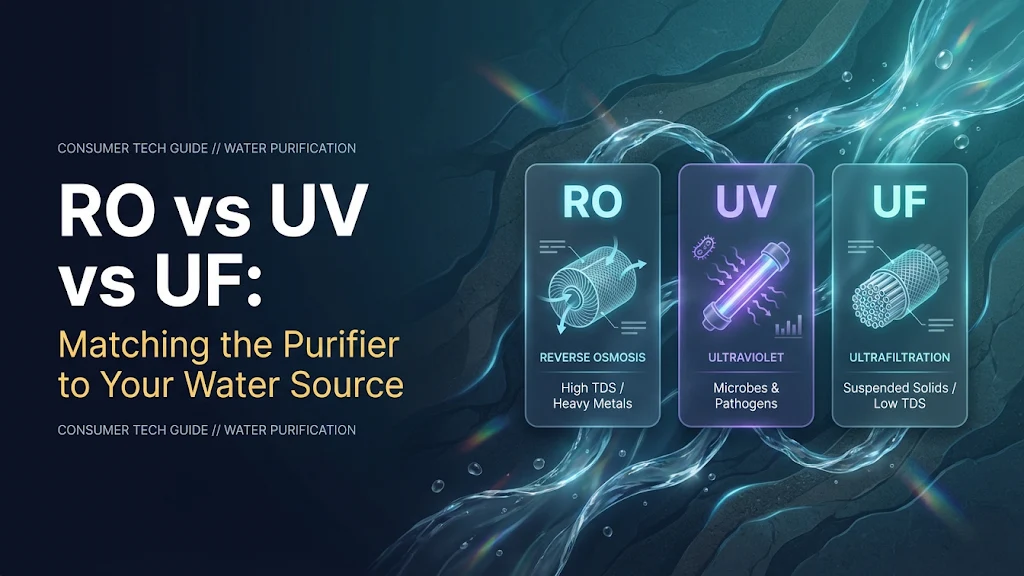
Many Indian homes also see UF (Ultrafiltration) purifiers in stores. UF uses a hollow-fibre membrane that traps bacteria, cysts, and floating dirt without using electricity. However, it cannot block dissolved salts or remove all viruses as reliably as UV or RO (Instacuppa, Boon).
Use this simple checklist for Indian homes:
- Municipal Tap Water (TDS below 300–500 mg/L): Choose a UV + UF purifier. UV kills bacteria and viruses, while UF clears muddy monsoon water and works as a backup during short power cuts.
- Borewell Water (TDS above 500 mg/L): Choose an RO + UV purifier. Borewell water in many Indian housing societies and independent houses has high dissolved salts, hardness, and sometimes excess fluoride (PPS Thane).
- Mixed Supply (Municipal + Tanker Water): Choose an RO + UV + UF purifier with a TDS Controller. Tanker water quality changes a lot across seasons. A TDS controller lets you adjust the final mineral level instead of stripping too many minerals from municipal water.
- Areas with Frequent Power Cuts & Low-TDS Water: A gravity-based UF purifier works without electricity. Still, boiling water is safer if you suspect viral contamination.
Cost, Water Wastage & Maintenance in India (₹)
The buying price is only half the cost. Entry-level RO+UV purifiers in India start around ₹6,299 and can go above ₹20,000 for premium models (Eureka Forbes, A.O. Smith). Standalone UV or UV+UF models usually cost less to buy and much less to run.
Here is how typical yearly upkeep costs break down in India (H2O Care, Bajaj Finserv):
- Sediment & Carbon Pre-filters (every 3–6 months): ₹150–₹400 for sediment filters and ₹300–₹700 for carbon filters.
- UV Lamp (once a year): ₹500–₹1,500.
- RO Membrane (every 12–24 months): ₹1,500–₹4,000, depending on the brand and your input water TDS.
- Annual Maintenance Contract (AMC): Basic service plans start around ₹599–₹1,500. Full brand AMCs that cover filters and membranes usually cost ₹3,000–₹6,000 a year for RO or RO+UV systems (Eureka Forbes, Water Purifier Clarity).
Is RO Water Safe for Daily Drinking?
Yes. RO water is safe for daily drinking as long as you service the purifier on time and do not let the TDS drop too low. If your RO water falls below 50 mg/L TDS, it can taste flat and lack calcium and magnesium (Chembond Water).
Follow these tips to keep RO water balanced:
- Keep TDS in a healthy range: Aim for an output TDS of about 50–150 mg/L (or up to 300 mg/L if you use a TDS controller).
- Change pre-filters on time: Regular filter changes stop bacteria from growing inside stagnant filter housings.
- Reuse reject water: Use RO waste water for mopping floors, washing utensils, or watering non-edible plants. This also aligns with the MoEF&CC 2023 rules.
Common Problems & Troubleshooting
- Slow water flow in an RO purifier: This usually happens when the sediment pre-filter is clogged or hard borewell water blocks the RO membrane. Check or replace the outer pre-filter spun candle first.
- Bitter or flat taste after RO: Your output TDS may be too low (<50 mg/L), or the post-carbon filter may be worn out. Ask a technician to check the TDS and adjust the TDS controller.
- Cloudy water from a UV purifier: UV light cannot remove cloudiness or mud. Clean or replace the sediment or UF cartridge, especially during the monsoon.
- Strange smell in stored water: Drain and clean the storage tank every 3–6 months, and replace activated carbon filters on schedule.
Final Takeaway
Do not buy an RO purifier just because it sounds “stronger.” Test your tap water’s TDS first.
If your TDS is under 500 mg/L from a reliable municipal supply with no chemical pollution, a UV + UF purifier is the better choice. It saves money, keeps natural minerals, and wastes zero water. If your home relies on high-TDS borewell or tanker water, an RO + UV purifier with a TDS controller is the safer investment.
Frequently Asked Questions (FAQs)
1. Can a UV water purifier reduce TDS?
No. A UV purifier uses ultraviolet light to disable bacteria, viruses, and other germs. It does not filter out dissolved salts, calcium, magnesium, or heavy metals. Your water’s TDS reading stays almost the same before and after passing through a UV purifier. If you need to lower high TDS, you must use an RO purifier.
2. Does a UV purifier remove dissolved salts and heavy metals?
No. UV technology only disinfects water; it is not a physical filter. Dissolved salts, fluoride, arsenic, lead, and hardness minerals pass right through a UV chamber unchanged. For groundwater or borewell water that contains dissolved chemical impurities, you need an RO membrane.
3. Does RO remove bacteria and viruses?
Yes. An RO membrane has tiny pores that physically block bacteria, viruses, and larger protozoa, flushing them out through the reject pipe. However, if a membrane gets a tiny tear or a seal loosens, germs can slip through. That is why many Indian purifiers pair RO with a UV or UF stage for extra safety.
4. What is the acceptable TDS level for drinking water in India?
Under the Bureau of Indian Standards (IS 10500:2012), the acceptable TDS limit for drinking water in India is 500 mg/L (ppm) (PIB). A higher limit of 2,000 mg/L is allowed only when no other drinking water source is available. Most water quality guides consider 50–150 mg/L ideal for taste.
5. Which water purifier is suitable for borewell water?
An RO + UV purifier—ideally with a pre-sediment filter and a TDS controller—is best for borewell water in India. Borewell water often has TDS levels above 500 mg/L, along with hardness salts and possible heavy metals or excess fluoride that UV or UF alone cannot remove.
Read This Also:
DPDP Act in India: 7 Ways India’s Privacy Law Protects Your Phone Data
1 thought on “RO vs UV Water Purifier: 5 Crucial Rules to Avoid Mineral Loss & Bad Taste”