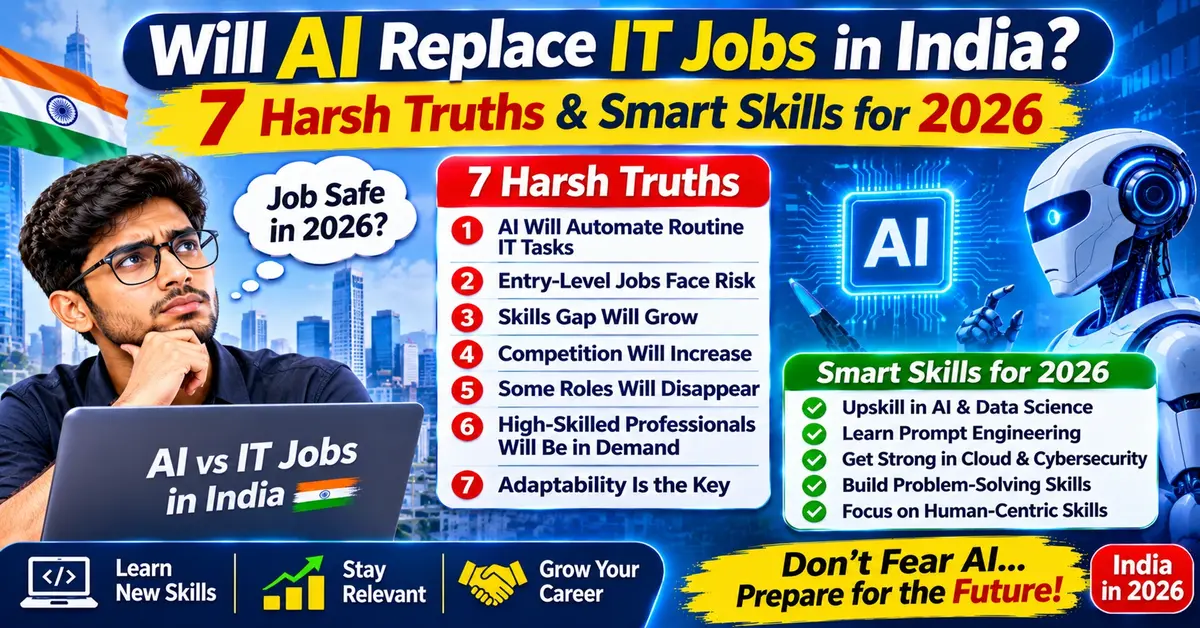
No, AI will not replace all IT jobs in India. However, it is quickly replacing routine, repetitive tech work. Entry-level boilerplate coding (standard, repetitive starter code), manual testing, and basic L1 support are shrinking. At the same time, demand is growing fast for engineers who can build, check, secure, and connect AI systems into real business workflows.
Key Takeaways
- Change, not a total wipeout: According to the World Economic Forum’s Future of Jobs Report 2025, tech shifts could replace 92 million jobs globally by 2030. However, they will also create 170 million new roles—a net gain of 78 million jobs.
- Hiring is shifting from numbers to skills: NASSCOM’s Strategic Review 2026 shows that Indian IT hiring is moving away from mass “volume” hiring toward a specialized “skill mix.”
- AI roles pay more: A World Bank report cited by PIB India (Feb 2026) notes that AI-focused roles in India offer an average 28% higher pay, compared to 12% for general digital skills.
- Southern hubs lead AI demand: Bengaluru (11% share), Hyderabad (9.57%), Pune (6.95%), and Chennai (6.62%) lead India’s white-collar AI job listings (PIB India).
- Coding still matters—just differently: Typing code by hand matters less today than fixing AI-written code, designing scalable systems, and understanding business needs.
Introduction
India’s tech and AI sector employs over 6 million people. It remains a major driver of middle-class career growth (PIB India). Still, worry across college campuses and tech parks is real. A NASSCOM Community report found that 68% of Indian IT professionals fear losing their jobs to AI, especially after the industry cut 25,000 to 30,000 roles during AI-led changes in 2025.
If you are a B.Tech, BCA, or MCA student—or an engineer with two to five years of experience—you do not need hype or panic. You need a clear look at what is changing in India’s IT sector, which jobs are at risk, and what skills companies are paying for in 2026.
Will AI Replace Software Engineers and Programmers?
AI tools will not replace software engineers as a career, because software engineering is much more than typing code.
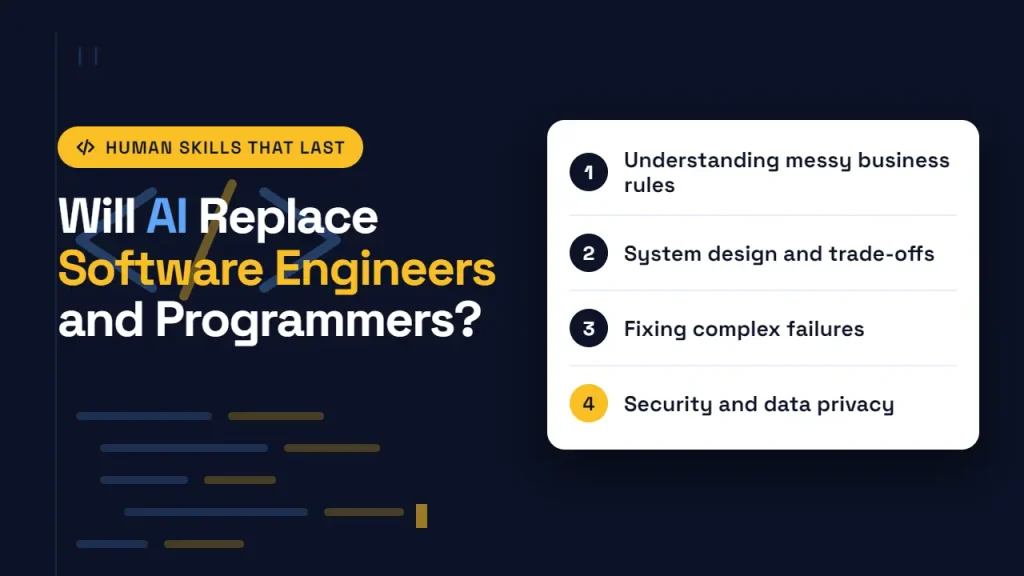
Modern AI coding assistants can write functions, create unit tests, and switch between programming languages in seconds. This makes one programmer much faster. However, real-world software engineering in Indian IT firms, startups, and Global Capability Centres (GCCs—offshore tech hubs run by global companies) involves tasks that AI still cannot handle on its own:
- Understanding messy business rules: Clients rarely give a clear, complete plan. Engineers must ask the right questions and turn unclear needs into working software.
- System design and trade-offs: Balancing speed (latency), cloud costs, security, and growth needs human judgment and accountability.
- Fixing complex failures: When a payment gateway or UPI service fails live, someone must trace logs across multiple systems and fix the root problem without breaking rules.
- Security and data privacy: Under laws like India’s Digital Personal Data Protection (DPDP) Act, companies cannot blindly paste private code or user data into unverified AI tools.
Bottom line: AI replaces typing code, not solving engineering problems. Programmers who use AI as a coding partner will do much better than those who refuse to adapt. Meanwhile, those who only copy-paste basic CRUD (Create, Read, Update, Delete) code will struggle to find jobs.
How AI Is Changing IT Jobs in India
For over 20 years, major Indian IT services companies grew by hiring tens of thousands of freshers each year for maintenance, manual testing, and routine support. That hiring model is changing fast.
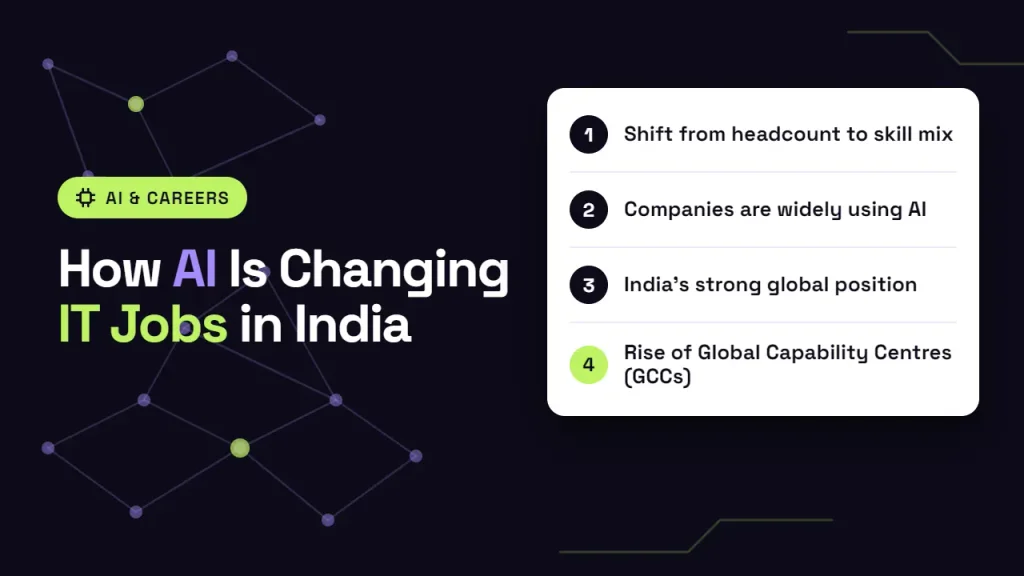
- Shift from headcount to skill mix: As NASSCOM’s Strategic Review 2026 notes, AI boosts productivity. This means companies need fewer people for repetitive work and more talent for cloud upgrades, data pipelines, and AI integration.
- Companies are widely using AI: According to the NASSCOM AI Adoption Index cited by PIB India, 87% of surveyed companies were actively using AI tools by late 2025.
- India’s strong global position: India ranks 3rd globally in Stanford University’s 2025 Global AI Vibrancy Ranking (behind only the US and China). Its AI skill penetration is 2.5 times higher than the global average (PIB India).
- Rise of Global Capability Centres (GCCs): Global banks, retail brands, and tech giants are growing their engineering hubs in Bengaluru, Hyderabad, Pune, and Chennai. They are building core AI and data products in India rather than only outsourcing basic support.
Which IT Jobs Are Affected by AI?
Not every tech role faces the same level of risk. Jobs built on predictable, rule-based steps face the highest pressure from automation. Roles that need system-level thinking, security skills, or team leadership remain strong.
| IT Role Category | AI Risk Level | What Is Changing | How to Stay Relevant |
|---|---|---|---|
| Manual QA / Basic Testing | High | AI writes test cases and runs automated checks faster. | Move into QA automation, API/performance testing, and checking AI outputs. |
| L1 IT Helpdesk & Support | High | AI chatbots and ticket tools fix routine password and access issues. | Upskill into cloud operations, Site Reliability Engineering (SRE—keeping systems online and stable), or L2/L3 support. |
| Boilerplate / Junior Web Coding | Medium-High | AI writes standard HTML/CSS, CRUD APIs, and basic UI screens. | Focus on full-stack design, state management, speed, and security. |
| Data Entry & Basic Reporting | High | Automated pipelines and AI dashboards clean data and build summaries. | Learn SQL optimization, data engineering, ETL pipelines (systems that move and clean data), and business storytelling. |
| Cloud, DevOps & Cybersecurity | Low | Complex cloud setups and AI-driven cyber threats increase the need for human control. | Master Kubernetes, CI/CD security (safe automated software releases), IAM (access control), and cloud cost control. |
| AI/ML & Data Engineering | Very Low (Growing) | High demand for clean data pipelines, model setup, and AI agent workflows. | Build projects in Python, SQL, RAG systems (connecting AI to company data), and MLOps (running AI models smoothly). |
Note: Job risk depends on company size and project complexity. Even in high-risk roles, professionals who supervise AI workflows remain valuable.
Which Jobs Will AI Create?
Instead of only cutting jobs, AI is creating new roles across Indian tech firms and GCCs. The World Economic Forum’s Future of Jobs Report 2025 lists Big Data Specialists, FinTech Engineers, AI and Machine Learning Specialists, and Software and Application Developers among the fastest-growing jobs through 2030.
In India, new and growing roles include:
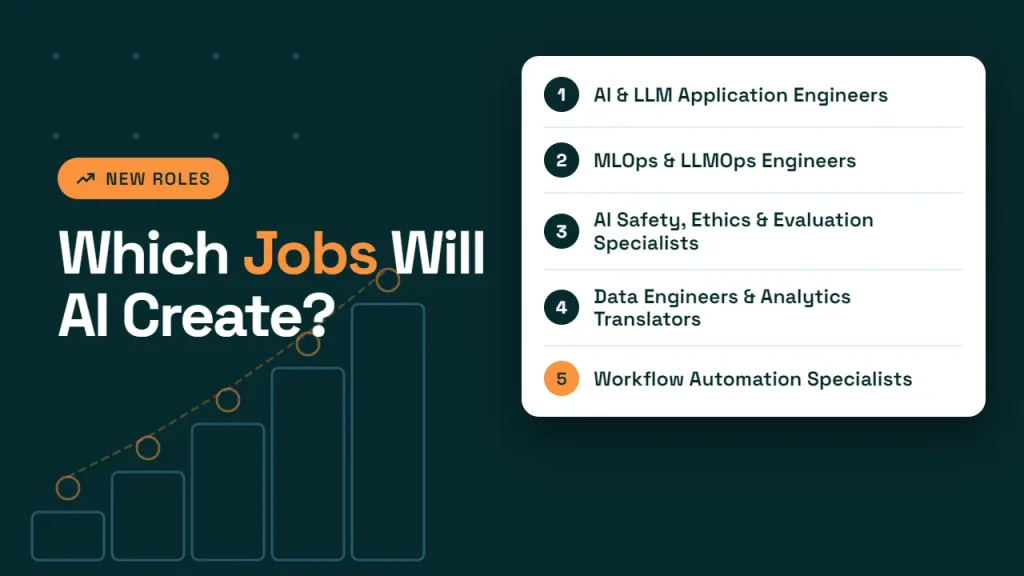
- AI & LLM Application Engineers: Developers who connect Large Language Models (LLMs—the AI behind tools like ChatGPT) to company databases using APIs, RAG, and safety rules.
- MLOps & LLMOps Engineers: Specialists who launch, monitor, and control the cost and speed of live AI models.
- AI Safety, Ethics & Evaluation Specialists: Professionals who test AI systems for hallucinations (made-up answers), bias, and rule compliance before release.
- Data Engineers & Analytics Translators: Experts who clean, organize, and manage the large datasets that AI models need.
- Workflow Automation Specialists: Builders who connect CRM, ERP, and internal tools using AI agents to automate multi-step business tasks.
Is Coding Still Worth Learning with AI?
Yes—coding is still worth learning, but how you learn and use it must change.
Skipping coding basics because “AI can write code” is one of the biggest mistakes students make today. When an AI tool writes 100 lines of Python or JavaScript, it can still add hidden security flaws, memory leaks, or broken edge cases. If you do not understand data structures, APIs, databases, and debugging, you cannot tell good code from risky code.
Think of AI like a calculator in engineering. Calculators did not remove the need to understand maths. They removed slow manual sums so engineers could solve harder problems. Learn Python, SQL, and one core backend or frontend language deeply. Then use AI tools to build faster, not to avoid thinking.
Best Skills for IT Students in 2026
To stand out in campus placements and off-campus hiring, computer science and IT students need strong tech basics, hands-on AI skills, and human judgment.
AI & Technical Skills for Future Technology Jobs
- Core Programming & Databases Develop strong knowledge of Python and SQL, along with Data Structures and Algorithms (DSA) for effective problem-solving.
- API Integration & Prompt Engineering Learn how to connect Large Language Model (LLM) APIs, write clear and structured prompts, and build reliable workflows using JSON outputs.
- Data Engineering Basics Understand how to clean datasets, create ETL (Extract, Transform, Load) pipelines, and use vector databases for AI-powered search.
- Cloud & DevOps Literacy Gain practical knowledge of AWS, Azure, or Google Cloud, along with Docker, Git, and automated software testing.
- Cybersecurity & Data Privacy Learn authentication, encryption, and secure data-handling practices to protect user information from unauthorized access and exposure through AI tools.
Human Skills AI Cannot Easily Replace
The World Economic Forum highlights analytical thinking, resilience, and creative problem-solving as important skills employers value alongside technical knowledge. Focus on developing these abilities:
- Verification & Critical Judgment Check AI-generated information carefully and identify answers that may sound confident but contain factual errors or unsafe recommendations.
- Problem Framing Learn to break complex business challenges into smaller, clear, and manageable technical steps.
- Communication & Stakeholder Empathy Explain technical ideas and decisions clearly to clients, product managers, and people without a technical background.
- Accountability & Ethical Decision-Making Take responsibility for system reliability, user privacy, and compliance with relevant laws and ethical standards.
How Students Can Prepare for AI Jobs in India (5-Step Action Plan)
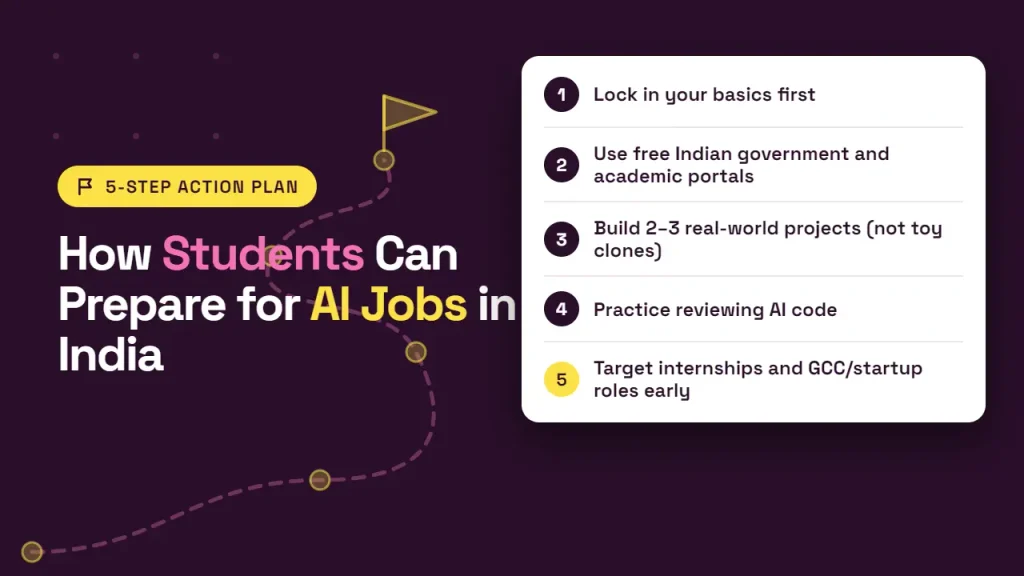
You do not need expensive ₹1 lakh+ bootcamps to get started. Follow this simple five-step plan:
- Lock in your basics first: Spend 8–10 weeks mastering Python, SQL, Git, and core computer science topics before jumping into advanced AI tools.
- Use free Indian government and academic portals:
- FutureSkills Prime (MeitY & NASSCOM): Offers 3,000+ industry-focused courses in AI, cloud, and big data, with over 25.3 lakh registered learners (PIB India).
- IndiaAI FutureSkills: Supports fellowships and NIELIT Data & AI Labs growing across Tier-2 and Tier-3 cities.
- YUVA AI for ALL: A free national starter AI course available in 11 Indian languages.
- Skill India Digital Hub (SIDH): Provides structured learning pathways in AI and machine learning, designed for learners from beginner to advanced stages.
- Build 2–3 real-world projects (not toy clones): Build a working project that solves a real problem—such as an AI invoice reader, a multilingual customer support bot in Indian languages, or a SQL analytics dashboard—and upload the code to GitHub.
- Practice reviewing AI code: Use an AI coding assistant to build a feature. Then check every line yourself for bugs, edge cases, and security risks, and note down what you fixed.
- Target internships and GCC/startup roles early: Apply to product startups and Global Capability Centres that test real building skills, rather than relying only on mass campus drives.
Final Takeaway
AI is not the end of IT careers in India—it is the end of routine, low-skill IT careers. The gap between passive coders and problem-solving engineers is growing fast. If you combine strong coding basics with practical AI skills, cloud knowledge, and human judgment, the AI shift in 2026 becomes a chance to get better work and higher pay—not a threat to your future.
Frequently Asked Questions (FAQ)
1. Will AI replace IT jobs in India completely?
No. AI automates repetitive tasks like boilerplate coding, data entry, and basic ticket handling, not entire engineering roles. According to PIB India, India’s tech sector employs over 6 million people and is shifting toward higher-value AI, cloud, and data roles rather than removing the workforce.
2. Which IT jobs are most at risk from AI in 2026?
Manual QA testing, L1 IT helpdesk support, basic data entry, and repetitive front-end or CRUD coding face the highest risk. These roles follow predictable rules that AI and automation tools can now do faster and at a lower cost.
3. Will AI replace software engineers in the next 5 years?
Software engineers who only write routine code face shrinking demand. However, engineers who design system architecture, manage cloud setups, fix complex live issues, and align software with business goals will stay in high demand.
4. Is coding still worth learning with AI around?
Yes. Even when AI writes the first draft of code, humans must understand coding logic, databases, and security to check, fix, and launch it safely. Without coding basics, you cannot spot AI mistakes or security risks.
5. Which IT jobs are safest from AI?
Cybersecurity engineering, cloud and DevOps architecture, data engineering, AI/ML engineering, Site Reliability Engineering (SRE), and technical product management are among the safest. These roles require deep system knowledge, security responsibility, and human judgment.
Read This Also:
10 Best AI Tools for Students : Study Smarter, Make Notes & Ace Exams