The BharatNet Scheme is the Government of India’s main rural broadband programme. Run by the Department of Telecommunications (DoT), it connects all Gram Panchayats (GPs) and inhabited villages with high-speed optical fibre—thin glass cables that carry fast internet (PIB).
The project is funded by the Digital Bharat Nidhi (DBN) and managed by BSNL under the ₹1,39,579 crore Amended BharatNet Program. It supports rural Fibre-to-the-Home (FTTH) connections, public Wi-Fi hotspots, and digital public services (PIB, CGCA Punjab).
Key Takeaways
- Scale: Over 2.18 lakh Gram Panchayats are now service-ready, supported by nearly 7 lakh km of optical fibre cable (OFC) (PIB, PIB).
- Major Upgrade: Approved in August 2023 with a ₹1,39,579 crore budget, the Amended BharatNet Program (ABP) upgrades the network to a loop-style ring topology that stays online even if a cable breaks. It also extends fibre to non-GP villages on demand (PIB).
- Implementing Agency: Bharat Broadband Network Limited (BBNL), which has been merged with BSNL. BSNL now serves as the single Project Management Agency (PMA) to run and maintain the network for 10 years (PIB, MaargX UPSC).
- Affordable Rural FTTH: Under the BharatNet Udyami model, rural homes and institutions can get BSNL FTTH connections (fibre internet straight to the building) with zero installation fees and monthly plans starting around ₹259 (BSNL Rural FTTH).
- Public Wi-Fi Reach: More than 1.04 lakh Wi-Fi hotspots have been set up under BharatNet, alongside over 4.10 lakh PM-WANI hotspots across India (PIB, PIB).
What Is the BharatNet Scheme?
Launched in October 2011 as NOFN, the government rebranded the initiative to BharatNet in 2015. Today, it is one of the largest rural telecom infrastructure projects in the world (PIB, MaargX UPSC).
Its main goal is non-discriminatory access—meaning every service provider gets equal access. Instead of giving rural internet control to just one private company, BharatNet builds an open optical fibre backbone. Telecom companies, Internet Service Providers (ISPs), cable TV operators, and local entrepreneurs can all use this network to offer affordable broadband in villages (PIB).
Who Funds and Manages BharatNet?
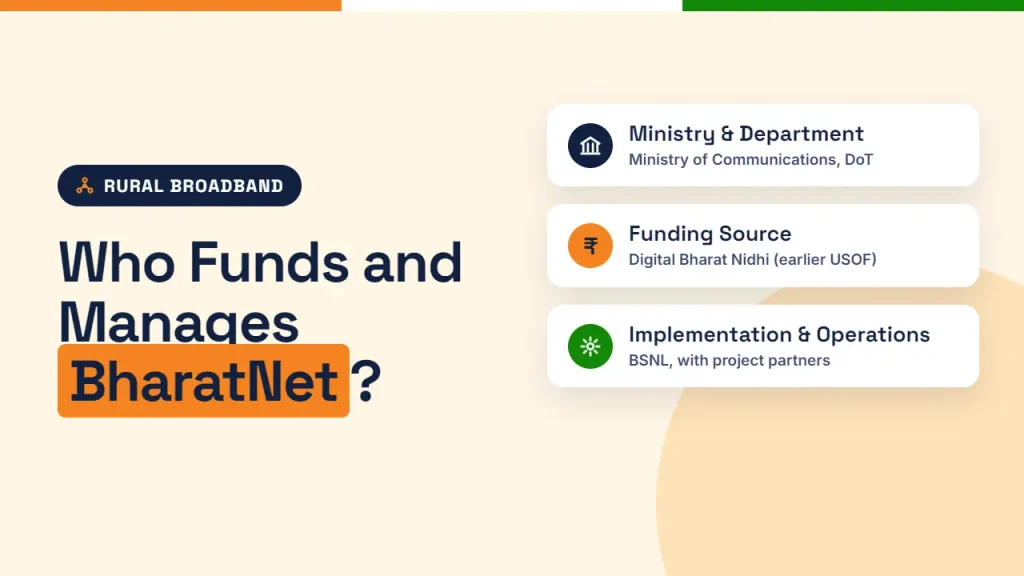
- Ministry & Department: Department of Telecommunications (DoT), Ministry of Communications (PIB).
- Funding Source: Digital Bharat Nidhi (DBN), which officially replaced the Universal Service Obligation Fund (USOF) under the Telecommunications Act, 2023 (CGCA Punjab).
- Implementation & Operations: At first, a Special Purpose Vehicle (a dedicated company created for a specific project) called Bharat Broadband Network Limited (BBNL) handled the rollout. BBNL merged with BSNL in 2022 (PIB, MaargX UPSC). Under the Amended BharatNet Program, BSNL acts as the single Project Management Agency (PMA) responsible for upgrading and maintaining the network for 10 years (PIB).
BharatNet Implementation Phases and the Revised Amended BharatNet Program (ABP)
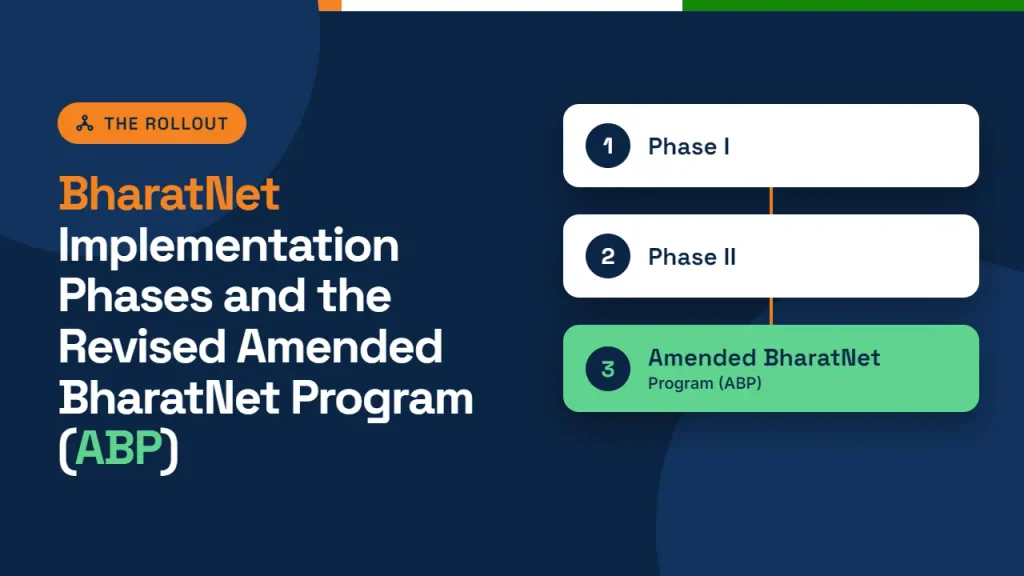
The Telecom Commission approved BharatNet in three phases in April 2016. This effort later led to the Amended BharatNet Program (ABP), which the Union Cabinet approved on 4 August 2023 (PIB, CGCA Punjab).
| Phase / Programme | Timeline & Status | Target Scope | Key Technology & Design | Approved Budget |
|---|---|---|---|---|
| Phase I | Completed Dec 2017 | 1 lakh Gram Panchayats | Underground OFC using existing PSU infrastructure | ₹42,068 crore (combined Phase I & II) (PIB) |
| Phase II | Ongoing / Nearing completion | Additional 1.5 lakh Gram Panchayats | OFC, overhead fibre, radio, and satellite (BSNL/BBNL) via State-led & CPSU models | Included in ₹42,068 crore (PIB, PIB) |
| Phase III / Amended BharatNet Program (ABP) | Approved Aug 2023; active rollout | Upgrade existing GPs + connect ~47,000 new GPs (total ~2.64 lakh GPs) + non-GP villages on demand | Ring topology (100% backup), IP-MPLS routers, RFMS monitoring, power backup, 10-year O&M | ₹1,39,579 crore (PIB, PIB) |
Why the Amended BharatNet Program Matters
Earlier phases used a linear topology, meaning cables ran in a single straight line. If road work or floods cut one cable, every village further down that line lost its internet connection.
The Amended BharatNet Program switches the network to a ring topology, which connects cables in a loop. If one side breaks, data automatically reroutes from the other direction. This setup aims for 98%+ uptime (PIB, PIB).
Latest Status of BharatNet in India (2025–2026)
Work has picked up speed on both laying physical fibre cables and connecting rural homes:
- Service-Ready Gram Panchayats: By March 2025, 2,18,347 GPs were service-ready. As of 31 October 2026, over 32,512 GPs had been upgraded specifically under the Amended BharatNet Program (PIB, Digital Bharat Nidhi).
- Optical Fibre Laid: Nearly 7 lakh km (6,92,676 km as of January 2025) of optical fibre cable has been laid under BharatNet (PIB, PIB).
- FTTH Connections: Over 14 lakh rural FTTH connections were active by January 2026, moving toward a national goal of 1.5 crore rural FTTH connections (PIB, DoT).
- State-Led Rollouts (2025–2026): Major ABP agreements are actively rolling out in Gujarat (₹5,691 crore covering 14,294 GPs and 30,000+ villages) (PIB), Chhattisgarh (₹3,942 crore) (PIB), Maharashtra (BSNL & MahaIT) (PIB), Tamil Nadu (TANFINET) (PIB), and Telangana (BSNL & T-Fibre) (PIB).
How Does BharatNet Work?
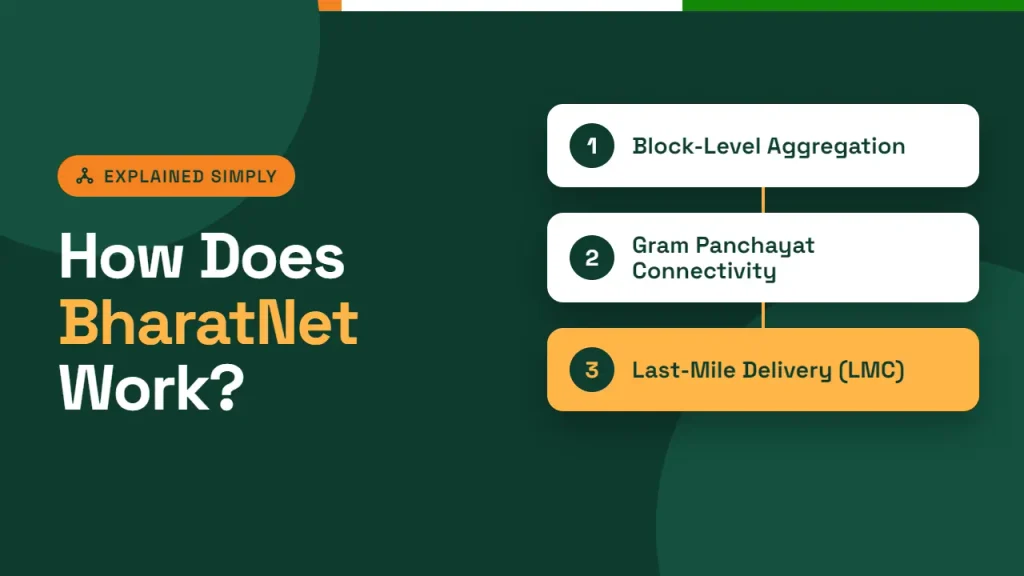
BharatNet delivers internet to rural India through a three-tier network (PIB, BSNL Rural FTTH):
- Block-Level Aggregation: High-capacity optical fibre starts at district and block headquarters fitted with IP-MPLS routers—high-speed network switches that direct internet traffic (PIB).
- Gram Panchayat Connectivity: Optical fibre reaches the Gram Panchayat Bhawan, where an Optical Line Terminal (OLT) or network node sits. In tough Himalayan, island, or forested areas, radio or satellite links are used instead (PIB, PIB).
- Last-Mile Delivery (LMC): From the Gram Panchayat node, internet reaches people through three channels:
- FTTH (Fibre to the Home): Local entrepreneurs (BharatNet Udyamis) or CSC Village Level Entrepreneurs (VLEs) pull overhead or underground drop cables straight to homes, shops, schools, and Primary Health Centres (BSNL Rural FTTH, PIB).
- Public Wi-Fi Hotspots: Wi-Fi access points are placed at Panchayat offices, markets, and bus stands (PIB).
- Dark Fibre / Bandwidth Leasing: Private telecom companies and cable operators rent spare fibre or bandwidth to expand 4G/5G mobile towers and local broadband (PIB).
How to Get a BharatNet FTTH Connection & Rural Plans
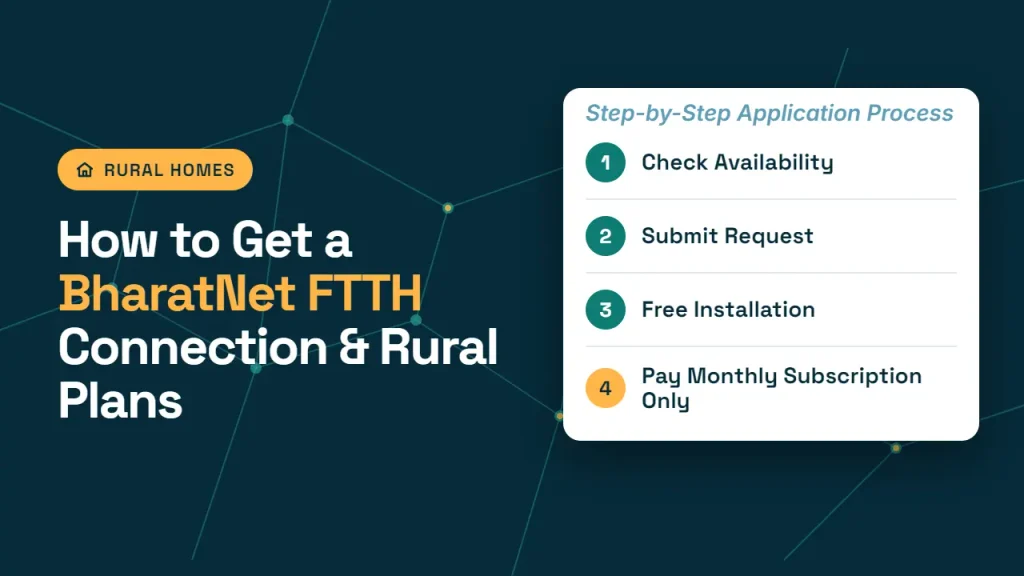
If you live in a Panchayat village or a nearby rural area, you can apply for a BSNL BharatNet FTTH connection. An authorised local partner, called a BharatNet Udyami (BNU), handles the setup and service (BSNL Rural FTTH).
Step-by-Step Application Process
- Check Availability: Visit the official BSNL Rural FTTH portal (ruralftth.bsnl.in) or contact your nearest Gram Panchayat office or BSNL Customer Service Centre (BSNL Rural FTTH).
- Submit Request: Share your address, mobile number, and Aadhaar/KYC details to request a new rural FTTH connection.
- Free Installation: Under the DBN-funded BharatNet scheme, installation is free for eligible rural homes, entrepreneurs, and government institutions. This includes the optical fibre drop cable and the Wi-Fi ONT modem (the router box that brings fibre internet to your devices) (BSNL Rural FTTH).
- Pay Monthly Subscription Only: Once your connection is active, you only pay the monthly plan charge on your first bill (BSNL Rural FTTH).
Sample BSNL Rural FTTH Plans (Indicative)
Note: Plan availability and OTT bundles may vary by telecom circle. Visit the official BSNL Rural FTTH portal to view the most recent broadband plans available in your state.
| Plan Name | Monthly Charge | Speed & FUP Data (High-Speed Limit) | Post-FUP Speed | Voice Calling |
|---|---|---|---|---|
| Fibre Rural Entry Plan | ₹259 / month | Up to 25 Mbps till 700 GB | 2 Mbps | Unlimited local & STD (BSNL Rural FTTH) |
| Fibre Rural Home WiFi (Ghar Ka WiFi) | ₹399 / month | Up to 40 Mbps till 1,400 GB | 4 Mbps | Unlimited local & STD (BSNL Rural FTTH) |
| Fibre Basic Plus OTT / Smart OTT | ₹699 / month | Up to 100 Mbps till 4,000 GB | 4 Mbps | Unlimited local & STD (BSNL Rural FTTH) |
BharatNet Wi-Fi Hotspots & PM-WANI Integration
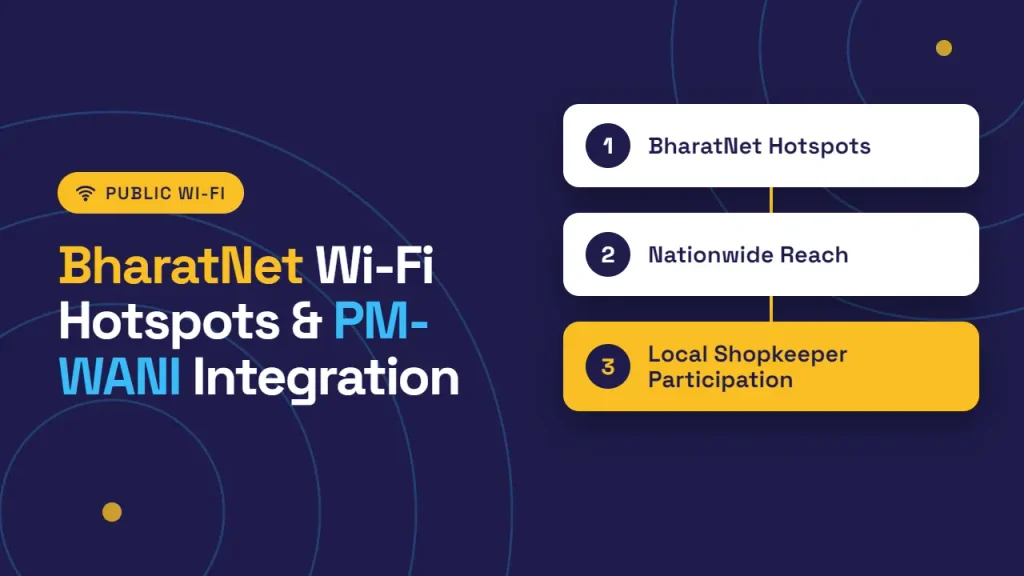
BharatNet works with the PM-WANI (Prime Minister’s Wi-Fi Access Network Interface) scheme to offer affordable public Wi-Fi without needing expensive mobile data packs (PIB):
- BharatNet Hotspots: 1,04,574 Wi-Fi hotspots have been installed directly under BharatNet, including setups through CSC-SPV (PIB).
- Nationwide Reach: Over 4.10 lakh PM-WANI hotspots were active across India as of June 2026 (PIB).
- Local Shopkeeper Participation: Small shopkeepers and rural entrepreneurs can register as Public Data Offices (PDOs) with no licence fee. They partner with PDO Aggregators to sell small data packs, including QR-code login options and 15-, 30-, and 60-minute plans introduced under May 2026 reforms (PIB, PIB).
Key Benefits & Real-World Challenges
Practical Benefits for Rural India
Gram Panchayats can help residents access land records, birth and death certificates, e-Shram registration and Direct Benefit Transfer (DBT) services. This can reduce the need to travel to distant tehsil offices for many services.
Reliable broadband can support digital classrooms in rural government schools and online doctor consultations through Health & Wellness Centres.
The BharatNet Udyami model and DBN–NABARD partnership can create income opportunities for local entrepreneurs who install, maintain and support village fibre connections.
Limitations & Ground-Level Challenges
Highway widening, excavation work and monsoon-related landslides can damage underground fibre cables. Ring topology and Remote Fibre Monitoring Systems (RFMS) can help improve network resilience and fault detection.
Unreliable electricity can interrupt connectivity when Gram Panchayat equipment loses power. Properly maintained batteries and solar backup systems can help reduce downtime.
A Gram Panchayat marked as service-ready does not automatically mean households are actively using broadband. Local awareness, affordable plans, last-mile connections and entrepreneur participation are important for increasing actual usage.
Frequently Asked Questions (FAQs)
1. What is the full form of BharatNet?
BharatNet stands for Bharat Broadband Network. It is India’s national rural optical fibre project, originally launched as the National Optical Fibre Network (NOFN) in 2011 and renamed BharatNet in 2015 (MaargX UPSC).
2. Which ministry runs the BharatNet scheme?
The Ministry of Communications oversees BharatNet through the Department of Telecommunications (DoT), with funding from the Digital Bharat Nidhi (DBN) (PIB, CGCA Punjab).
3. Is BBNL still separate from BSNL?
No. Bharat Broadband Network Limited (BBNL), the Special Purpose Vehicle created in 2012 to run BharatNet, merged into BSNL in 2022. Under the Amended BharatNet Program, BSNL serves as the single Project Management Agency (PIB, MaargX UPSC).
4. How many Gram Panchayats are connected under BharatNet?
As of March 2025, 2,18,347 Gram Panchayats were service-ready. The Amended BharatNet Program aims to upgrade existing GPs and connect about 47,000 more—targeting roughly 2.64 lakh GPs and all remaining inhabited villages on demand (PIB, PIB).
5. Is BharatNet Wi-Fi free in villages?
Installation of a BharatNet FTTH connection—including the cable and Wi-Fi ONT router—is free under the DBN-funded scheme, but monthly broadband plans are paid (starting around ₹259/month) (BSNL Rural FTTH). Public Wi-Fi hotspots may offer limited free access or low-cost short-term plans depending on the operator or PM-WANI PDO (PIB).
Final Takeaway
BharatNet has grown from a basic cable-laying project into a full rural broadband network. It now combines loop-based ring reliability, Digital Bharat Nidhi funding, PM-WANI public Wi-Fi, and zero-installation-cost BSNL FTTH (PIB, BSNL Rural FTTH). If you live in a rural area and want steady home or shop internet, check your village’s FTTH availability on the BSNL Rural FTTH portal or at your local Gram Panchayat office.
2 thoughts on “BharatNet Scheme (2026): Latest Status, How It Works & Rural FTTH Guide”