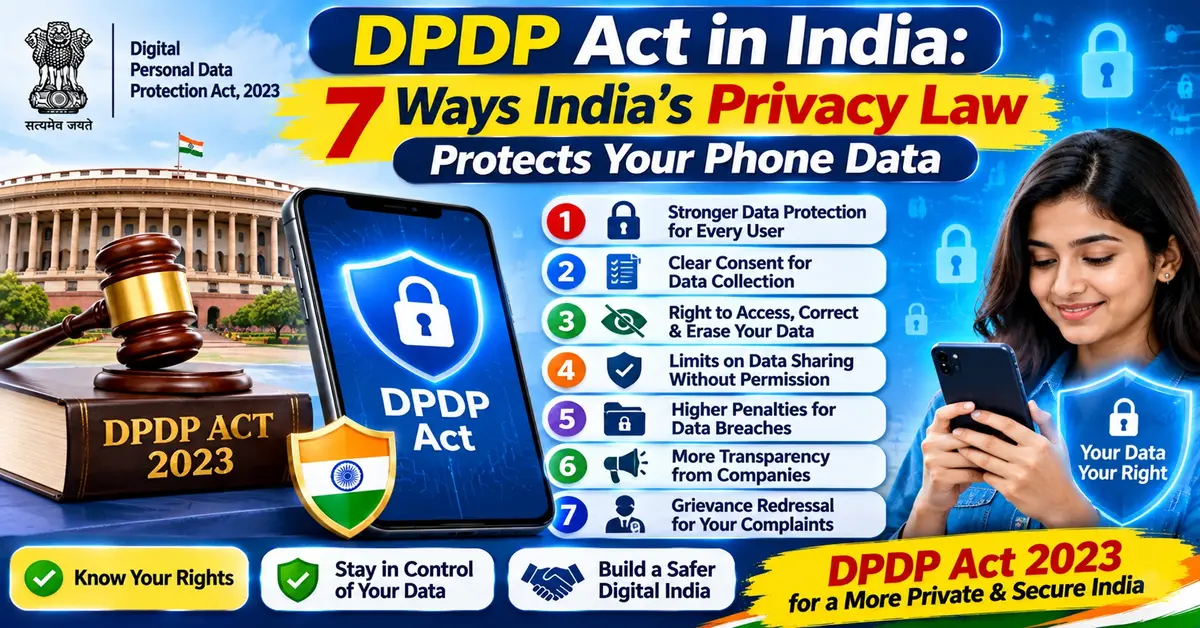
The DPDP Act, 2023 is India’s core data privacy law. Parliament enacted it on 11 August 2023, and the government put it into action through the DPDP Rules, 2025 (PIB Backgrounder).
This law gives Indian citizens control over their digital personal data. It forces apps and companies to ask for your clear permission before collecting your details. Companies that fail to keep your data safe face fines of up to ₹250 crore (MeitY Gazette).
Key Takeaways
- Consent first: Apps and websites must show a clear, simple notice and get your clear permission before collecting your data (PIB Backgrounder).
- Phased Implementation: The government officially issued the DPDP Rules, 2025 in November 2025. Consent Manager registration opened on 13 November 2026, and full day-to-day company rules start on 13 May 2027 (Legismith Timeline).
- Stronger child safety: Anyone under 18 needs verifiable permission from a parent or guardian. Apps cannot track, monitor, or show targeted ads to children (DPDP Act Section 9).
- Easy exit: You can take back your permission at any time and ask a company to delete your data. The company must respond within 90 days (PIB Backgrounder).
- Heavy fines: Companies that fail to protect your data or report a data leak face fines of up to ₹250 crore per violation (PIB Backgrounder).
Understanding the DPDP Act: A Plain-Language Guide
In simple words, the DPDP Act is a rulebook for apps, banks, websites, and businesses in India. It tells them how they must handle your personal details, such as your name, phone number, Aadhaar-linked records, location, photos, or shopping history.
Earlier, companies often hid data-sharing terms inside 30-page legal policies that nobody could read. Now, the DPDP Act follows the government’s SARAL (Simple, Accessible, Rational, and Actionable) approach. Every organisation must explain in plain language what data it is taking and why it needs it (PIB Backgrounder).
This law also puts the Supreme Court’s landmark Puttaswamy ruling—which recognised privacy as a fundamental right—into everyday digital practice (Legal500).
The law applies to:
- Digital personal data collected in India, whether collected online or collected on paper and later digitised (PIB Backgrounder).
- Foreign companies outside India, if they offer goods or services to people in India (ComplyDP).
Key Terms You Should Know
To understand how the DPDP Act protects your privacy, you only need to know five everyday terms defined in the Act (PIB Backgrounder):
| Term | Simple Meaning | Everyday Indian Example |
|---|---|---|
| Data Principal | You—the individual whose personal information is being gathered. For a child under 18, it includes their parent or legal guardian. | You signing up for a UPI app, banking portal, or food delivery account. |
| Data Fiduciary | Any company, app, or organisation that decides why and how your data is used. | Swiggy, Flipkart, HDFC Bank, Instagram, or an EdTech app. |
| Significant Data Fiduciary (SDF) | Large or high-risk companies named by the government that must follow stricter checks and appoint a Data Protection Officer in India. | Major social media platforms, large banks, or healthcare networks (once notified). |
| Data Processor | A third-party vendor that handles your data on behalf of a Data Fiduciary. | A cloud hosting provider or SMS OTP service used by your bank. |
| Consent Manager | A registered Indian platform that lets you view, manage, or withdraw app permissions from one dashboard. | A single privacy dashboard where you can turn off permissions across many apps. |
Understanding the DPDP Rules 2025: A Guide to the 3-Phase Implementation (2025–2027)
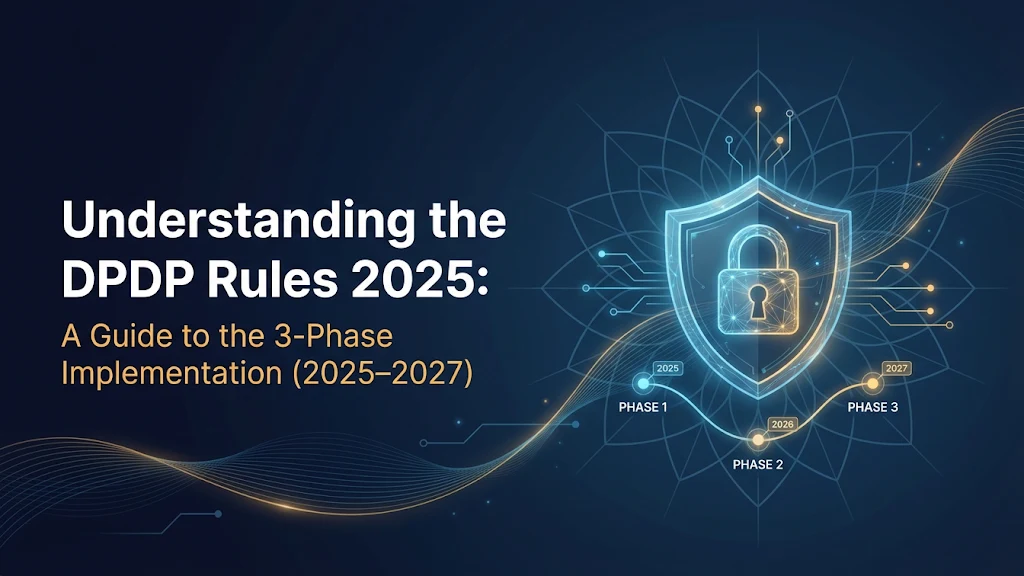
The Indian Parliament officially passed the DPDP Act in August 2023.The day-to-day rules arrived when the Ministry of Electronics and Information Technology (MeitY) notified the DPDP Rules, 2025 in November 2025 (PIB Backgrounder).
To give Indian startups, MSMEs, and large companies time to update their systems, the government set an 18-month phased timeline (Legismith Timeline):
| Phase | Effective Date | What Becomes Active |
|---|---|---|
| Phase 1: Foundation | 13–14 November 2025 | Launch of the four-member, digital-first Data Protection Board of India (DPBI), core definitions, and the RTI Act amendment (PIB Backgrounder, Legismith). |
| Phase 2: Consent Managers | 13 November 2026 | Official registration opens for Consent Managers (which must be companies based in India) to build shared consent dashboards (Converge Digital). |
| Phase 3: Full Enforcement | 13 May 2027 | All day-to-day company rules start: point-by-point consent notices, data leak alerts, security safeguards, children’s data rules, and the 90-day user request deadline (UniConsent, Legismith). |
What Personal Data Are Mobile Apps Allowed to Collect Under India’s DPDP Act?
Apps cannot collect whatever they want just because you installed them. Under the Act’s rules of purpose limitation (using data only for the agreed reason) and data minimisation (taking only the minimum data needed), an app can only collect details that are strictly necessary for the service you asked for (PIB Backgrounder).
Apps can legally process your data in only two ways (ComplyDP):
- With your clear consent: For example, a shopping app can ask for your phone number and delivery address to ship an order. If it also wants to send promotional WhatsApp messages or share your profile with advertisers, it must ask separately.
- For “Certain Legitimate Uses” (Section 7): These are special situations where showing a pop-up consent screen every time is not practical. Examples include when you share your number at a clinic, during a medical emergency or disaster, for job records, or to receive government subsidies and benefits (DPDP Act Section 7).
Practical check: Suppose a simple flashlight or PDF scanner app asks for your contacts, call logs, and constant GPS location. Once full enforcement starts in May 2027, that breaks the data minimisation rule.
Understanding DPDP Act Consent Rules: How Permission Works and How to Withdraw It
To be valid under the DPDP Act, consent must be freely given, specific, well-informed, unconditional, and clearly expressed. This means pre-ticked boxes or “accept all or leave” tricks are not allowed for unrelated data uses (UniConsent).
Every Data Fiduciary must also show clear contact details of a designated officer or Data Protection Officer for privacy questions (PIB Backgrounder).
How to Withdraw Consent Under the DPDP Act
Taking back your permission must be as easy as giving it (PRS India). Follow these steps:
- Open the app’s privacy or account settings: Look for the privacy dashboard or the Data Protection Officer contact link required under the Rules (PIB Backgrounder).
- Use a registered Consent Manager (rolling out 2026–2027): Once Consent Managers launch under the November 2026 framework, you can turn off permissions for multiple apps from one central platform (Converge Digital).
- Submit a withdrawal request: Ask the app to stop using your data and delete it if it is no longer legally needed. Keep in mind that withdrawing consent does not undo data use that happened lawfully before you withdrew (DPDP Act Section 6).
- Wait up to 90 days for action: Under the DPDP Rules, 2025, companies must reply to your access, correction, update, or deletion requests within 90 days (PIB Backgrounder).
- Complain to the Data Protection Board: If the company ignores your request, you can file an online complaint on the digital-first Data Protection Board portal or mobile app. Appeals against the Board’s orders go to TDSAT (the Telecom Disputes Settlement and Appellate Tribunal) (PIB Backgrounder).
DPDP Act User Rights (and Your Duties)
As a Data Principal, the Act and Rules give you six clear rights (PIB Backgrounder):
- Right to Know: Ask what personal data a company holds, why it collected the data, and who it shared the data with.
- Right to Access: Ask for a summary or copy of your personal data held by a company.
- Right to Correct and Update: Fix wrong, incomplete, or old details, such as an old phone number or address.
- Right to Erase: Ask a company to delete your data once its purpose is over or after you withdraw consent. Companies can still keep data if another Indian law—such as banking or tax rules—requires it.
- Right to Grievance Redressal: Expect a reply from the company’s contact officer, and take unresolved complaints to the Data Protection Board.
- Right to Nominate: Name another person to manage your data rights on your behalf in case of death or incapacity.
Important user duty: You also have legal duties under the Act. You must not pretend to be someone else, hide key facts when applying for official documents, or file false or silly complaints. Breaking these duties can lead to a fine of up to ₹10,000 (Unified Chambers).
Social media apps, short-video platforms, and messaging services rely heavily on user profiling and targeted ads. Under the DPDP rules, three major things change for you:
- No bundled consent: Platforms must separate basic account features from optional ad tracking or third-party data sharing (ComplyDP).
- Plain-language breach alerts: If your password, phone number, or private profile details leak, the platform must inform both the Data Protection Board and affected users without delay. It must explain in plain language what happened and how you can stay safe (PIB Backgrounder).
- Extra checks for major platforms: Large social media networks named as Significant Data Fiduciaries must run independent data audits and Data Protection Impact Assessments (privacy risk checks) (PIB Backgrounder).
Children’s Data Protection in India (Under-18 Rules)
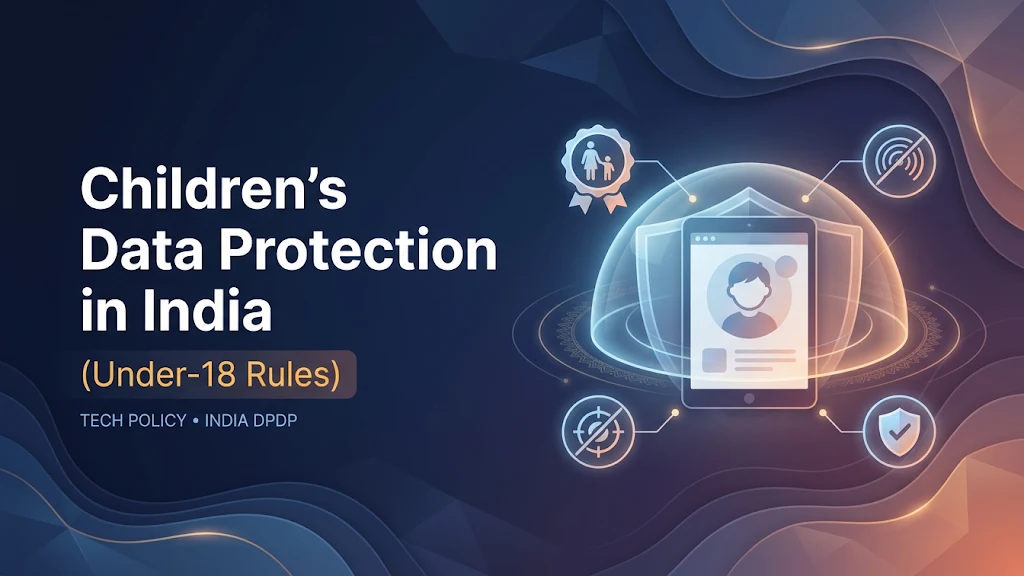
One of the strictest parts of the DPDP Act is Section 9, which protects anyone under 18 years of age. This is a higher age bar than Europe’s GDPR (13–16) or the US COPPA (13) (K&S Partners).
Under Section 9 and Rule 10 of the DPDP Rules, 2025 (DPDP Act Section 9, Legal500):
- Verifiable parental consent: Before any gaming, EdTech, or social media app uses a child’s data, it must verify and get permission from a parent or legal guardian.
- No tracking or behaviour monitoring: Apps cannot track a child’s browsing habits or build behaviour profiles.
- No targeted ads: Showing targeted ads to children under 18 is strictly banned.
- No harmful data use: Apps cannot use children’s data in ways likely to harm their well-being.
Limited exemptions exist for essential services like healthcare, education, and real-time child safety. The government may also set lower age limits for platforms that prove their data handling is verifiably safe (PIB Backgrounder, DPDP Act Section 9).
DPDP Act Penalties: What Happens If Companies Break the Law?
Unlike older Indian IT rules where fines were small, the DPDP Act brings heavy financial penalties decided by the Data Protection Board of India (PIB Backgrounder, Unified Chambers):
| Violation | Maximum Penalty |
|---|---|
| Failing to keep reasonable security safeguards to prevent a data breach | Up to ₹250 crore |
| Failing to inform the Board and affected users about a personal data breach | Up to ₹200 crore |
| Breaking rules on children’s data (Section 9) | Up to ₹200 crore |
| Breaking extra duties as a Significant Data Fiduciary (Section 10) | Up to ₹150 crore |
| Any other violation of the Act or Rules | Up to ₹50 crore |
| A user (Data Principal) filing false complaints or impersonating someone (Section 15) | Up to ₹10,000 |
Limitations and Exemptions You Should Know
To keep expectations realistic, it helps to know what the DPDP Act does not cover:
- Offline paper records: Physical registers and handwritten forms are excluded unless they are digitised (PIB Backgrounder).
- Publicly available data: If you post your phone number or photo on a public social media profile yourself, the Act’s consent rules do not stop others from viewing it.
- State and national security exemptions: Government agencies can process data without consent for national security, sovereignty, public order, or preventing crimes (PRS India).
- RTI Act changes: Section 44(3) updates Section 8(1)(j) of the RTI Act to protect personal information. However, Section 8(2) still allows sharing data when public interest outweighs privacy harm (PIB Backgrounder).
Final Takeaway
India’s DPDP Act and DPDP Rules, 2025 mark a big shift from blindly clicking “Accept” to having real digital control. With Consent Manager registration live from November 2026 and full company enforcement arriving on 13 May 2027 (Legismith), now is a good time to check the permissions you have given to shopping, banking, and social apps—and remove any app that asks for more data than it truly needs.
Frequently Asked Questions (FAQ)
1. What is the DPDP Act in simple words?
The DPDP Act (Digital Personal Data Protection Act, 2023) is India’s national privacy law. It controls how apps, websites, and companies collect, store, and use your digital personal data (PIB Backgrounder). It forces organisations to ask for clear permission before taking your data and imposes fines of up to ₹250 crore if they fail to keep it safe.
2. When does the DPDP Act come into full force in India?
The DPDP Rules, 2025 were notified in November 2025 with an 18-month phased rollout (PIB Backgrounder). The Data Protection Board framework began in November 2025, Consent Manager registration opened on 13 November 2026, and full compliance rules—including consent notices, children’s data protections, and breach reporting—start on 13 May 2027 (Legismith Timeline).
3. What is the difference between a Data Fiduciary and a Data Principal?
A Data Principal is the person whose personal data is collected—meaning you, or a parent/guardian acting for a child under 18 (PIB Backgrounder). A Data Fiduciary is the company, app, bank, or organisation that decides why and how your personal data is used.
4. Can apps track or show targeted ads to children under 18 in India?
No. Under Section 9 of the DPDP Act, any person under 18 is legally a child (DPDP Act Section 9). Apps must get verifiable permission from a parent before using a child’s data. They are strictly banned from tracking, monitoring behaviour, or showing targeted ads to children—with fines up to ₹200 crore for violations (Legal500).
5. How long does a company have to delete or update my data under the DPDP Act?
Under the DPDP Rules, 2025, companies (Data Fiduciaries) must reply to your requests to access, correct, update, or delete personal data within 90 days (PIB Backgrounder). However, companies may keep data if another Indian law, such as banking or tax rules, requires them to hold it.
Read This Also:
Android Security Sandbox Explained: 5 Hidden APK Risks & Safety Guide (2026)