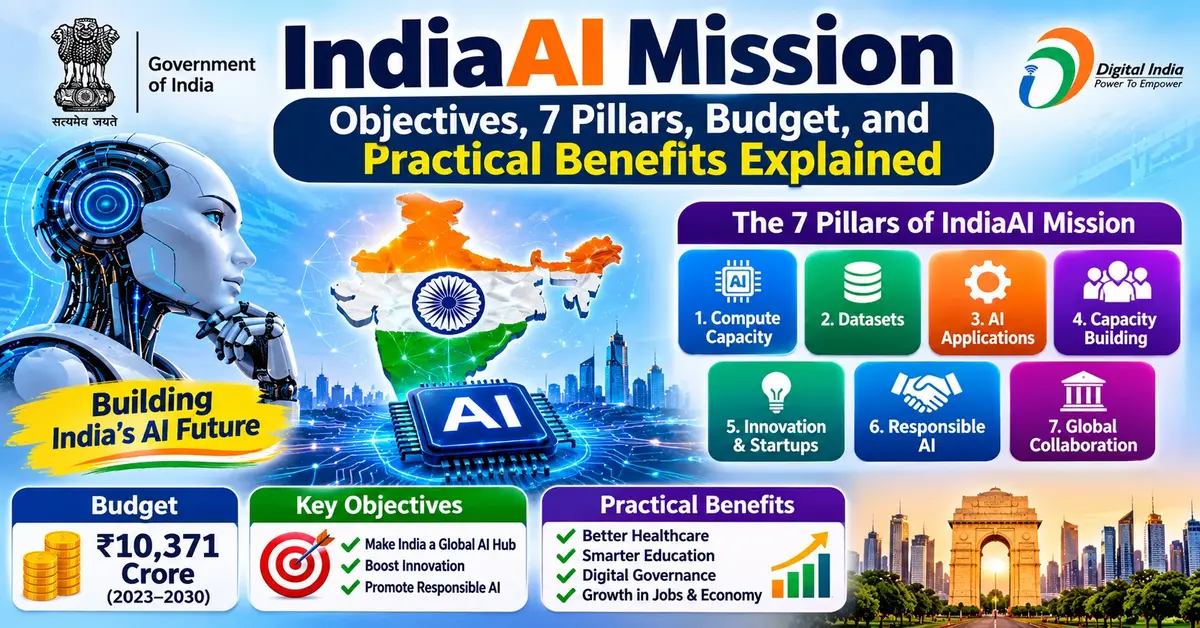
The IndiaAI Mission is a national program approved by India’s Union Cabinet (the top decision-making body of the government) on March 7, 2024. It has a budget of ₹10,371.92 crore (about $1.25 billion) over five years. Run by the “IndiaAI” Independent Business Division under the Ministry of Electronics and Information Technology (MeitY), the project aims to make artificial intelligence accessible across India. It focuses on seven main pillars: public computing power (10,000+ graphics processing units, or GPUs), homegrown AI models, the AIKosh dataset library, practical AI apps, student training and fellowships, startup funding, and safe AI rules.
Key Takeaways
- Budget: ₹10,371.92 crore (about $1.25 billion) allocated from 2024 to 2029 to build self-reliant digital and computing infrastructure. (Note: One crore equals 10 million rupees.)
- Shared Computing Power: A shared pool of high-end GPUs—such as NVIDIA H100s, Intel Gaudi 2, and AMD MI300X—offered to Indian startups and researchers at discounts of up to 40%, with rates starting near ₹65 (about $0.78) per hour.
- Homegrown AI Models: Around ₹1,971 crore reserved through the IndiaAI Innovation Centre to build sovereign Large Multimodal Models (LMMs)—AI systems that can process text, images, and audio—trained on Indian languages.
- Student Support: Fellowships and training for 8,000 undergraduate, 5,000 graduate, and 500 PhD students across Indian colleges and universities.
- National Oversight: Managed by the IndiaAI Independent Business Division under MeitY and guided by the new India AI Safety Institute.
1. What Is the IndiaAI Mission?
The IndiaAI Mission is India’s official plan to build its own artificial intelligence technology. Approved in March 2024, the initiative helps close the gap in computer power, data, and funding that separates Indian creators from giant global tech companies.
INDIAAI MISSION
Budget: ₹10,371.92 Cr (5 Years)
Lead Agency: MeitY (DIC)
IndiaAI Compute
10,000+ GPUs
Up to 40% OffFoundation Models
Homegrown LLMs/
Multimodal AI
AIKosh Platform
Unified Datasets &
National Sandbox
Application Development
Health/Agri/Gov
FutureSkills
13,500 Scholars
500 PhD Fellows
Startup Financing
Venture Capital and
Direct Grants
Safe & Trusted AI
Safety Audits &
Deepfake Defense
The Indian government is not building state-run server farms from the ground up. Instead, it uses a public-private partnership model. The government groups national demand together, partners with commercial cloud and data center providers, and subsidizes processing time for domestic startups, universities, and small businesses.
The project is run by the IndiaAI Independent Business Division, part of the Digital India Corporation under MeitY. This structure allows the team to operate with the speed of a private tech company while remaining accountable to the public.
2. Why the Mission Matters: The Need for Sovereign AI
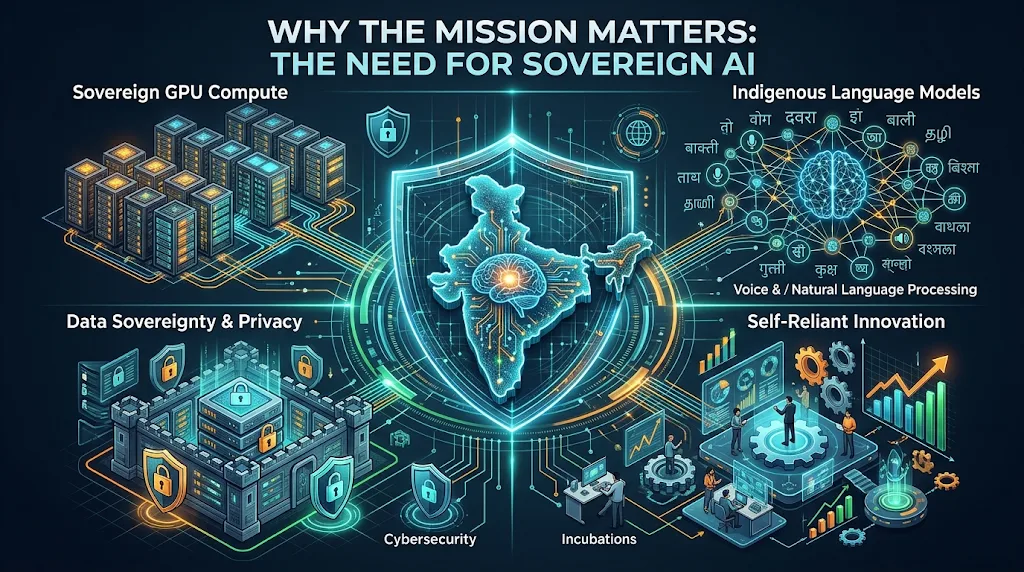
Most global AI development relies on massive computer clusters and base models trained on Western text and media. India has 1.4 billion people, 22 official languages, and thousands of regional dialects. Relying only on foreign AI creates several major challenges:
- Language and Cultural Blind Spots: Mainstream global AI models often make factual errors or show cultural bias when working with regional Indian languages.
- High Costs for Local Startups: Training advanced AI requires thousands of specialized chips. Renting an eight-chip NVIDIA H100 server at regular commercial cloud rates can cost ₹2,500 to ₹3,500 (about $30 to $42) an hour. These high prices lock early-stage Indian startups out of core AI research.
- Data Privacy and Security: Vital public systems—such as digital land records, national health data, and the Unified Payments Interface (UPI) financial network—must follow Indian privacy rules under the Digital Personal Data Protection (DPDP) Act.
The IndiaAI Mission solves these problems by treating computing power, data, and software as Digital Public Infrastructure (DPI)—the same public-utility approach India used to build Aadhaar (digital ID), UPI (instant payments), and ONDC (open e-commerce).
3. The Seven Pillars of the IndiaAI Mission
The mission works across seven connected areas covering every stage of AI development:
| Pillar Name | Primary Focus | Key Goals and Targets |
|---|---|---|
| 1. IndiaAI Compute Capacity | Hardware and GPU access | Set up 10,000+ GPUs; offer computing as a service with subsidies of up to 40%. |
| 2. IndiaAI Innovation Centre | Homegrown foundation models | Build sovereign Indian AI models; selected 12 teams (such as BharatGen). |
| 3. AIKosh (Datasets Platform) | Access to non-personal data | Provide 3,000+ public and private datasets across 20+ national sectors. |
| 4. Application Development | Solving India-specific problems | Roll out AI tools for healthcare, farming, climate, and government services. |
| 5. IndiaAI FutureSkills | Education and talent training | Fund 500 PhDs, 5,000 master’s students, and 8,000 undergrads; build AI labs. |
| 6. IndiaAI Startup Financing | Risk capital for deep-tech | Provide direct grants, equity funding, and working capital to AI startups. |
| 7. Safe & Trusted AI | Ethics, safety, and security | Launch the India AI Safety Institute; build tools to catch deepfakes and bias. |
Pillar 1: IndiaAI Compute Capacity
Computing power is the engine behind modern generative AI. Under this pillar, the government is assembling a national high-performance computing network. Through public tenders, MeitY selected commercial cloud vendors that offer top-tier AI chips, including the NVIDIA H100, H200, and A100, Intel Gaudi 2, AMD MI300X, and AWS Trainium.
Instead of waiting years for new state-owned data centers to open, researchers and startups can rent computing time right away through a unified government portal. Subsidies drop the price to as low as ₹65 (under $1) per GPU hour for approved projects.
Pillar 2: IndiaAI Innovation Centre (Foundation Models)
With a budget of about ₹1,971 crore, this pillar funds the development of native Large Multimodal Models (LMMs) and Small Language Models (SLMs). The government selected 12 Indian teams, startups, and academic partnerships to build models trained directly on Indian languages and cultural contexts. Grantees include:
- BharatGen: A collaborative academic initiative spearheaded by IIT Bombay to develop multilingual foundational models.
- Commercial Startups: Sarvam AI, Gnani AI, Soket AI, Gan AI, and Shodh AI.
- Corporate Labs: Tech Mahindra Maker’s Lab and Fractal Analytics Ltd.
These selected groups receive full subsidies for their computing costs. They also get an extra 25% cash grant to help pay for datasets, fine-tuning, and specialized engineering talent.
Pillar 3: AIKosh (IndiaAI Datasets Platform)
AI models need clean, well-labeled training data to work well. AIKosh serves as India’s centralized national data platform. It gives researchers streamlined access to:
- Non-personal data from national and state government agencies.
- Curated open-source Indian language voice and text samples, organized with the Bhashini language division.
- A secure digital “sandbox” where developers can test algorithms on real data without exposing private personal information.
Pillar 4: IndiaAI Application Development Initiative
This pillar finances AI projects designed to solve real-world social problems. Priority areas include:
- Agriculture: Pest detection tools, smart irrigation tracking, and local-language farming tips.
- Healthcare: Affordable AI tools to screen for tuberculosis and cancer at rural health clinics.
- Legal and Governance: Automated document checks, citizen complaint routing, and fast translation of court rulings.
Pillar 5: IndiaAI FutureSkills
To solve the country’s shortage of machine learning engineers, this pillar expands academic training outside major metropolitan hubs:
- Direct Fellowships: Financial stipends for 500 doctoral (PhD) scholars, 5,000 master’s students, and 8,000 undergraduate engineering students.
- Campus Labs: Opening 27 flagship Data and AI Labs, with plans to expand to more than 500 colleges in smaller cities and towns (tier-2 and tier-3 regions).
Pillar 6: IndiaAI Startup Financing
Deep-tech startups often take years of research and development before they make a profit. This pillar works with local venture capital firms, the Small Industries Development Bank of India (SIDBI), and MeitY programs to offer:
- Direct equity investments and milestone-based research grants.
- Easier access to government contracts by waiving standard past-revenue requirements.
Pillar 7: Safe & Trusted AI
As AI tools spread, risks such as deepfakes and biased algorithms grow. This pillar builds safety protections:
- India AI Safety Institute: Launched in early 2025 to create national benchmarks and run safety tests on major AI models.
- Detection Tools: Native programs like Saakshya (a deepfake detection tool developed by IIT Jodhpur and IIT Madras) and AI Vishleshak (audio-visual forensics software).
4. How Startups, Students, and Researchers Can Access Benefits
How to Access IndiaAI Resources
The IndiaAI portal provides different application pathways for startups, businesses, students, academic institutions and researchers.
STARTUPS & BUSINESSES
- Register with DPIIT, where required.
- Create an account on indiaai.gov.in.
- Submit a computing-resource request.
- Apply for eligible government-supported compute benefits or vouchers.
STUDENTS & ACADEMIA
- Obtain university nomination, where required.
- Apply through the relevant IndiaAI fellowship portal.
- Complete the merit-based selection process.
- Receive a stipend if selected under an eligible fellowship.
RESEARCHERS
- Prepare a well-documented research proposal.
- Identify a relevant priority sector.
- Check and apply to suitable MeitY or IndiaAI grant calls.
- Explore eligible computing credits and grant support.
For Startups and Small Businesses (Computing Subsidies)
- Get Registered: Confirm your startup is registered with India’s Department for Promotion of Industry and Internal Trade (DPIIT).
- Open an Account: Register on the official IndiaAI Portal.
- Submit Your Plan: Describe your technical goals, the hardware you need (such as an 80GB NVIDIA H100 or Intel Gaudi 2), your estimated GPU hours, and your model details.
- Receive Credits: Once an expert panel approves your project, you receive digital vouchers you can spend with approved commercial cloud vendors.
For Students and Scholars (Fellowships)
- Check Eligibility: You must be enrolled in an approved Indian university studying computer science, data science, electronics, or a related field.
- Apply Online: Look for application notices on the MeitY and NIELIT portals, which open twice a year.
- Get Department Approval: Have your college department head or dean sign off on your application. Selected students receive monthly stipends deposited directly into their bank accounts.
For Researchers (Datasets and Grants)
- AIKosh Access: University researchers can request API access to AIKosh using an approved university email address (.edu.in or .ac.in).
- Apply for Grants: Labs working on bias reduction, deepfake detection, or regional language tools can apply directly to open government grant calls (called Expressions of Interest) under the Innovation Centre and Safe AI pillars.
5. Economic Impact and Real-World Uses
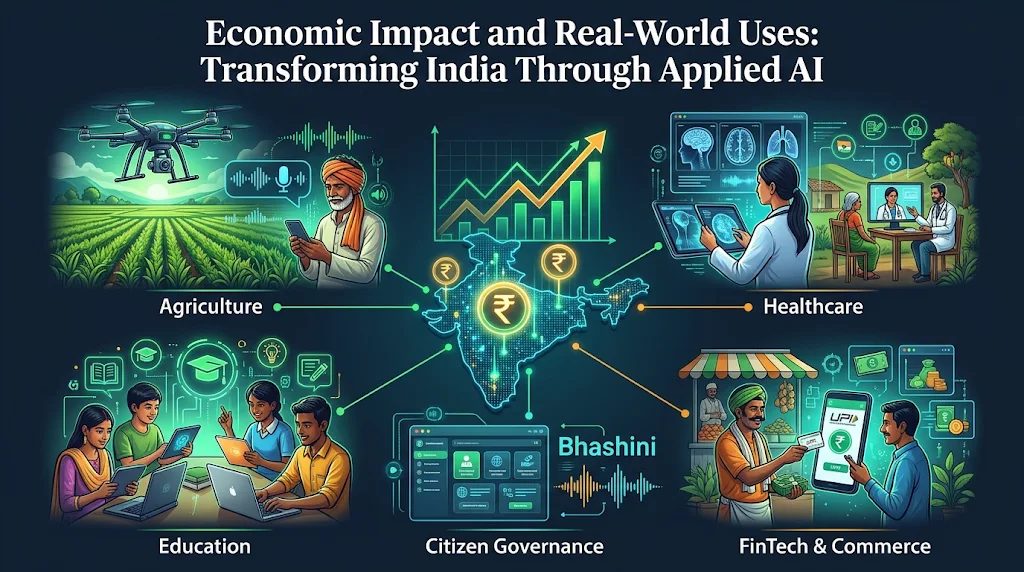
The IndiaAI Mission is designed to help the broader economy by supporting practical AI tools across several key sectors:
Projected Sector Impact of AI in India
HEALTHCARE
AI-assisted diagnostic tools and chest X-ray analysis can support healthcare professionals, particularly in rural clinics.
AGRICULTURE
Soil and water monitoring, along with local weather alerts, can help farmers make better-informed decisions.
GOVERNANCE
Automated case routing and digital assistance systems can help improve public-service delivery.
LANGUAGES
Real-time voice translation and language technologies can improve digital access across India’s 22 scheduled languages.
1. Healthcare: Rural Medical Screening
Healthcare facilities in rural regions across India experience a deficit of qualified medical specialists. Through the application fund, hospitals and startups are rolling out AI tools that analyze chest X-rays and eye scans. For example, screening systems for tuberculosis and diabetic eye damage now run on portable, low-power devices. This allows rural patients to get quick test results without traveling to big cities.
2. Agriculture: Weather-Smart Farming
By pairing satellite imagery from ISRO (India’s space agency) with local ground sensors and historical rainfall data, AI platforms deliver precise farming advice. Voice-based phone assistants give farmers personalized fertilizer tips and pest warnings in their local dialects.
3. Public Services: Voice Access in Regional Languages
Connecting IndiaAI with the Bhashini translation system lets citizens interact with government programs using their voice. Whether a farmer in Bihar asks about subsidy payments in Maithili, or a weaver in Tamil Nadu tracks loan programs, voice tools help people access public services even if they cannot read or write.
6. Challenges and Strategic Roadblocks
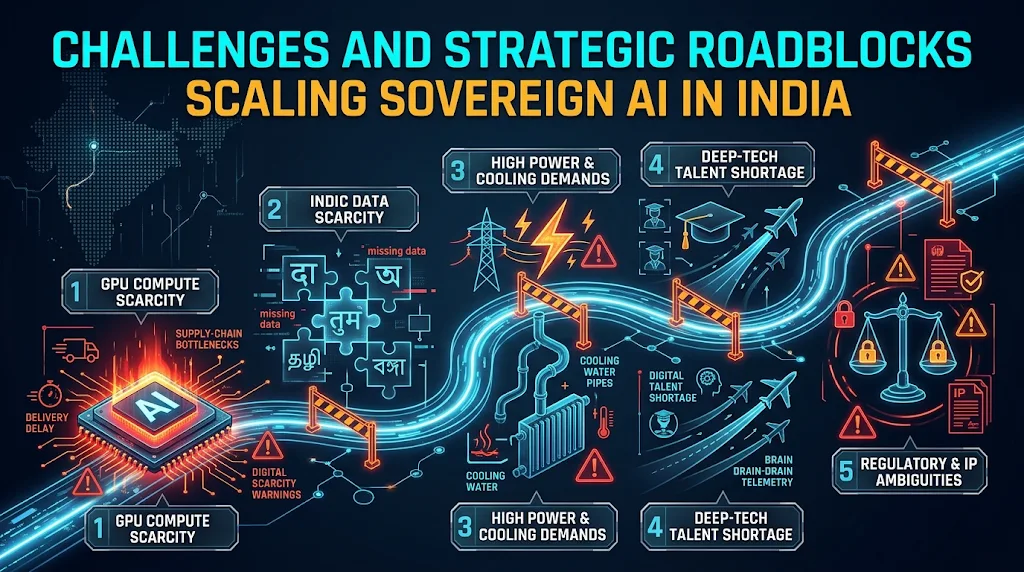
While the program has strong funding, it faces several real-world hurdles:
- Reliance on Imported Hardware: India currently imports all its advanced AI chips. Global supply shortages or trade restrictions could slow down progress. This makes India’s companion semiconductor program (the India Semiconductor Mission) critical for long-term independence.
- Power and Water Demands: Large AI data centers use immense amounts of electricity and cooling water. Building sustainable facilities will require clean energy from solar and wind power grids in western and southern industrial hubs.
- Data Gaps in Rare Languages: Digitized text and clean audio are still scarce for tribal dialects and lesser-spoken regional languages. Creating high-performing models will require extra time and funding to collect clean data.
- Brain Drain: Top Indian AI engineers and researchers often receive high-paying job offers from tech firms in Silicon Valley and Europe. Keeping researchers in India will depend on offering competitive pay and easy access to top-tier hardware.
7. The Road Ahead: India’s Sovereign AI Path
The IndiaAI Mission functions as much more than a standard technology grant. It serves as the foundation for India’s digital independence. By offering cheap computing power, funding local AI models, sharing public data, and creating safety rules, the initiative levels the playing field for Indian developers.
For Indian founders, engineers, and students, the program removes the high computing costs that once kept advanced AI out of reach. Over the next five years, the mission’s true success will not just be measured by technical scores. It will be judged by how well AI improves public healthcare, supports small businesses, and drives economic growth across the country.
Frequently Asked Questions (FAQs)
What is the budget of the IndiaAI Mission?
The IndiaAI Mission has a total budget of ₹10,371.92 crore (about $1.25 billion). India’s Union Cabinet approved this funding for a five-year period running from 2024 to 2029.
Who launched the IndiaAI Mission?
India’s Union Cabinet, led by Prime Minister Narendra Modi, approved the mission on March 7, 2024. The Ministry of Electronics and Information Technology (MeitY) manages the program through the IndiaAI Independent Business Division under Digital India Corporation.
What comprise the seven core pillars of the IndiaAI Initiative?
The seven pillars are:
- IndiaAI Compute Capacity
- IndiaAI Innovation Centre (Foundation Models)
- AIKosh (Datasets Platform)
- IndiaAI Application Development Initiative
- IndiaAI FutureSkills
- IndiaAI Startup Financing
- Safe & Trusted AI
How many GPUs will be provided under the IndiaAI Mission?
The program aims for a minimum shared pool of 10,000 high-end GPUs. By partnering with commercial cloud vendors, the government reports that total available capacity has scaled to more than 38,000 GPU units at subsidized rates.
Can college students get fellowships under the IndiaAI Mission?
Yes. Through the FutureSkills pillar, the government funds fellowships for 8,000 undergraduate, 5,000 graduate, and 500 PhD students. Eligible students enrolled in technology and engineering programs at recognized Indian universities can apply through the official IndiaAI portal during open application cycles.
Read This Also:
India Semiconductor Mission: Policy, Approved Fabs & 5 Major Projects