
Quantum computing is a branch of computer science and engineering that uses quantum physics—such as superposition and entanglement—to process information (IBM). Regular computers store data as binary bits (0 or 1). Quantum computers use quantum bits (qubits) instead. This lets them check many possible answers at the same time to solve complex simulation, optimisation, and security problems (BQP).
Key Takeaways
- Not a faster laptop: Quantum computers do not replace your PC or smartphone. They act as specialised tools for hard problems that even supercomputers struggle to solve (IBM, BQP).
- Three core mechanisms: Qubits use superposition, entanglement, and quantum interference to search huge mathematical spaces at once (LatentView).
- India’s ₹6,003.65-crore push: Approved in April 2023, the National Quantum Mission (NQM) aims to build 50 to 1,000 physical qubits over eight years across four Thematic Hubs (Anantam IAS).
- Indigenous hardware milestone: Bengaluru-based QpiAI launched QpiAI-Indus on World Quantum Day 2025. It is India’s first full-stack 25-qubit superconducting quantum computer (PIB).
- Accessible learning in India: Students and engineers can start for free on MeitY’s QSim simulator or NPTEL’s Qiskit course. You can also pursue M.Tech programmes at IISc Bengaluru and IIT Madras.
Introduction
Classical silicon chips power everything from UPI payments to space missions. However, they hit a limit when asked to model complex molecules or test trillions of delivery routes at once (PIB, IBM). Quantum computing tackles these problems by using subatomic physics instead of shrinking silicon transistors further (IBM).
If you are an engineering student, a software developer, or preparing for competitive exams like UPSC or GATE, understanding quantum computing is very useful today. This guide explains how quantum computers work, where they help, and how India is building its own quantum ecosystem.
How Quantum Computing Works

A regular computer processes data using bits. These are tiny electrical switches that are strictly either 0 (off) or 1 (on) (BQP). Quantum computers replace those switches with qubits. Engineers can build qubits from superconducting circuits, trapped ions, photons (light particles), or neutral atoms.
Four quantum principles make this possible (LatentView):
- Superposition: Until you measure it, a qubit can exist as a mix of both 0 and 1 at the same time. Think of a spinning coin before it lands on heads or tails (IBM, BQP). As you add more qubits, the number of states a system can hold grows very fast.
- Entanglement: Two or more qubits can link together so their states match, no matter how far apart they are. Changing one entangled qubit affects its partner right away. This lets quantum gates run complex calculations across many qubits at once.
- Quantum Interference: Qubits behave like probability waves. Quantum algorithms use interference to boost the chance of getting the right answer while cancelling out wrong answers before measurement (LatentView).
- Measurement and Collapse: Once a quantum circuit finishes running, measuring the qubits forces each one to settle into a definite 0 or 1 (BQP). Because quantum results are based on probability, systems often run the same task thousands of times in seconds to find the most reliable answer.
Classical Computing vs. Quantum Computing

Quantum machines work alongside—not instead of—classical supercomputers and cloud servers (BQP).
| Feature | Classical Computer | Quantum Computer |
|---|---|---|
| Basic unit | Bit (0 or 1) (BQP) | Qubit (superposition of 0 and 1) (IBM) |
| Processing style | Step-by-step or standard parallel steps (LatentView) | Checks massive state spaces at once using interference (BQP) |
| Best suited for | Web apps, databases, video, daily tasks, standard AI | Molecular simulation, complex optimisation, cryptography (IBM) |
| Operating conditions | Room temperature with air or liquid cooling | Often near absolute zero in dilution refrigerators (for superconducting qubits) (LatentView) |
| Error behaviour | Very low hardware error rates | Sensitive to noise and decoherence; needs error correction (NPTEL) |
Key Applications of Quantum Computing
Large, error-free quantum machines are still being built. Even so, researchers and companies are focusing on four major areas (IBM):
Healthcare, Pharma, and Materials Science
Molecules follow quantum rules, making some chemical simulations difficult for conventional computers. Quantum computers could help researchers study molecular behaviour, protein structures, catalyst design, and advanced battery materials. These capabilities may support drug-discovery research in India’s pharmaceutical sector and clean-energy innovation.
Cybersecurity and Quantum-Safe Encryption
Powerful future quantum computers could threaten widely used RSA and elliptic-curve encryption. Banks, telecom companies, and defence organisations are therefore exploring Post-Quantum Cryptography (PQC), which uses mathematical methods designed to resist known quantum attacks. Quantum Key Distribution (QKD) can also help detect attempts to intercept quantum key exchanges.
Logistics, Mobility, and Finance
Planning delivery routes, managing traffic, and balancing investment portfolios can involve many possible combinations. Hybrid quantum-classical computing approaches aim to solve certain complex optimisation problems more efficiently by combining quantum processors with conventional computers.
Climate Modelling and Engineering Simulation
Aerospace, automotive, and climate researchers need advanced tools to model complex physical systems. Quantum and quantum-inspired computing methods are being explored for applications such as airflow simulation, power-grid optimisation, and weather-related modelling.
Quantum Computing in India: National Mission, Hubs, and Startups
India has moved from early college research to a focused national plan backed by government funding and private deep-tech startups.
1. National Quantum Mission (NQM)

The government approved the National Quantum Mission in April 2023 with a budget of ₹6,003.65 crore for 2023–24 to 2030–31. The Department of Science and Technology (DST) coordinates the mission, making India the seventh country with a dedicated national quantum programme (Wikipedia, Anantam IAS). Its main goals include building quantum computers with 50 to 1,000 physical qubits over eight years and setting up 2,000 km of secure QKD communication links (Anantam IAS).
Under NQM, DST set up four Thematic Hubs (T-Hubs) at top institutes (Anantam IAS):
- Quantum Computing: Indian Institute of Science (IISc), Bengaluru
- Quantum Communication: IIT Madras
- Quantum Sensing and Metrology: IIT Bombay
- Quantum Materials and Devices: IIT Delhi
2. MeitY’s QSim Toolkit and C-DAC
Before NQM, the Ministry of Electronics and Information Technology (MeitY) teamed up with IISc Bengaluru, IIT Roorkee, and C-DAC to launch QSim (Quantum Computer Simulator Toolkit) in August 2021 (PIB). QSim gives Indian students and researchers a free simulator to write, test, and debug quantum circuits with or without simulated noise (PIB). C-DAC is also building a quantum reference facility in Bengaluru under NQM (Wikipedia).
3. Leading Quantum Computing Companies and Startups in India

India’s private quantum sector has grown quickly. Eight startups have been selected under NQM (PIB), alongside major Indian IT firms building quantum teams:
- QpiAI (Bengaluru): Launched QpiAI-Indus on World Quantum Day in April 2025. It is India’s first full-stack 25-qubit superconducting quantum computer, backed by $32 million in Series A funding co-led by Avataar Ventures and NQM (PIB, DeepTech Navigator). In August 2026, QpiAI also opened a quantum chip foundry in Bengaluru that can make processors up to 128 qubits (The Quantum Insider).
- QNu Labs (Bengaluru): Focuses on quantum-safe cybersecurity, including QKD, Quantum Random Number Generators (QRNG), and PQC. It raised ₹200 crore in Series A1 funding (QNu Labs, DeepTech Navigator).
- BQP (formerly BosonQ Psi): Builds quantum-inspired engineering simulation software that runs on existing HPC (high-performance computing) and GPU clusters for aerospace, defence, and manufacturing (InterviewBit, BQP).
- Quanfluence (Bengaluru): Develops photonic (light-based) quantum computing hardware (InterviewBit).
Quantum Computing Institutes and Courses in India
You do not need to go abroad to study or build a career in quantum technology in India.
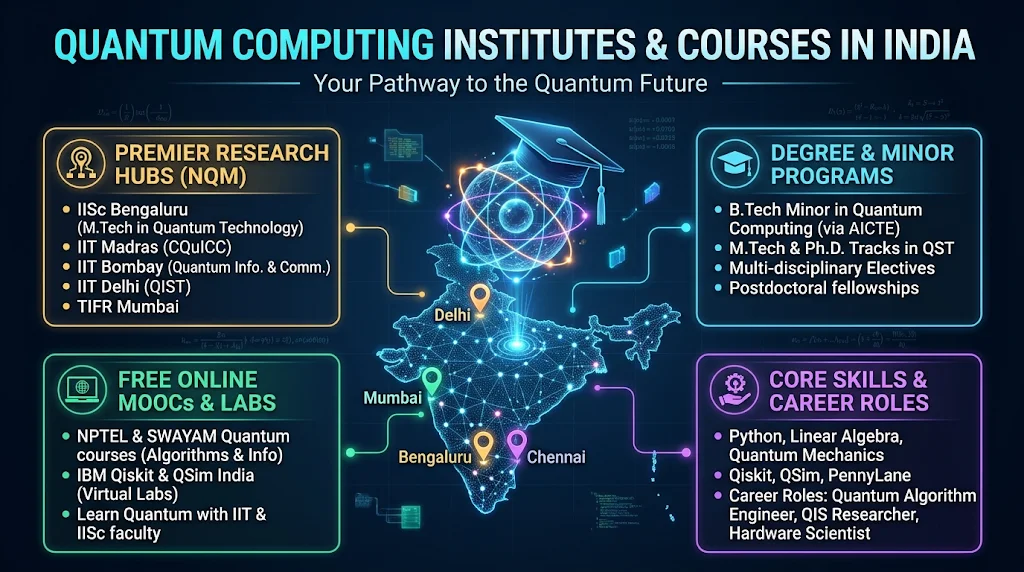
Postgraduate Degrees (GATE-based and Interdisciplinary)
- IISc Bengaluru: Offers a two-year M.Tech in Quantum Technology. It accepts valid GATE scores across engineering and science subjects (IISc Admissions).
- IIT Madras: Runs an Interdisciplinary Master’s Programme in Quantum Science and Technologies (QuST) across Physics, Electrical Engineering, Mathematics, and Computer Science (IIT Madras OGE).
- IIT Bombay, IIT Delhi, and IIT Kanpur: Offer dedicated M.Tech, dual-degree, or B.Tech minor specialisations in quantum computing and quantum science (Allegiance Educare).
Note: AICTE and the Office of the Principal Scientific Adviser have also released a Model Curriculum for M.Tech in Quantum Technologies so more Indian universities can start similar degrees.
Online and Certificate Programmes
- NPTEL / SWAYAM (Free to audit): Courses like IIT Madras’s Introduction to Quantum Computing: Quantum Algorithms and Qiskit only require basic linear algebra and Python. You can also take an optional proctored exam for a certificate (NPTEL).
- IIT Delhi CEP & IIT Madras CODE: Offer 6-month executive and professional certificate programmes in quantum computing and quantum machine learning for working engineers (IIT Delhi CEP).
Limitations, Challenges, and Common Misconceptions
Despite fast progress, today’s quantum computers are still in the Noisy Intermediate-Scale Quantum (NISQ) stage—meaning they are small and prone to errors (QpiAI-Indus / Wikipedia):
- Decoherence and Noise: Tiny vibrations, heat, or electromagnetic interference cause qubits to lose their quantum state within microseconds—a problem called decoherence (Embedded.com).
- Error Correction Overhead: Making one reliable “logical qubit” currently takes many noisy physical qubits working together to fix errors.
- Not Universal Speedups: For everyday tasks—like streaming video, running databases, or writing code—regular computers remain far cheaper, faster, and more practical (BQP).
Final Takeaway
Quantum computing is moving from physics theory into real-world engineering. India has built a strong base through the ₹6,003.65-crore National Quantum Mission, four IIT/IISc Thematic Hubs, and local hardware and security startups (PIB, Anantam IAS). If you want to try it yourself today, revise basic linear algebra and Python, join an NPTEL Qiskit course, and test circuits on MeitY’s QSim simulator.
Frequently Asked Questions (FAQ)
1. What is quantum computing in simple words?
Quantum computing uses quantum physics instead of standard electronics to process data. Regular computers store information as 0s or 1s. Quantum computers use qubits that can hold combinations of 0 and 1 at the same time, helping them solve complex simulation and optimisation problems (IBM, BQP).
2. What is a qubit?
According to IBM, a qubit (quantum bit) serves as the fundamental unit of data in quantum computing. Unlike a regular bit, which must be either 0 or 1, a qubit can exist in a mix of both states (superposition) until it is measured (BQP). Qubits are made from physical systems like superconducting circuits, trapped ions, or photons.
3. Has India built its own quantum computer?
Backed by the National Quantum Mission, Bengaluru startup QpiAI unveiled QpiAI-Indus in April 2025, marking India’s maiden full-stack 25-qubit superconducting quantum system (PIB). In 2026, QpiAI also opened a quantum chip foundry in Bengaluru to scale processors further (The Quantum Insider).
4. What is the National Quantum Mission (NQM) of India?
Launched in April 2023 with a ₹6,003.65-crore budget through 2030–31, NQM is a Department of Science and Technology (DST) mission. Its goal is to build Indian quantum computers (50–1,000 physical qubits), secure quantum communication networks, quantum sensors, and quantum materials across four Thematic Hubs at IISc Bengaluru, IIT Madras, IIT Bombay, and IIT Delhi (Anantam IAS, PIB).
5. Which Indian companies and startups are working on quantum computing?
Key Indian quantum startups include QpiAI (full-stack superconducting quantum systems), QNu Labs (quantum-safe encryption and QKD), BQP / BosonQ Psi (quantum-inspired simulation software), and Quanfluence (photonic quantum hardware) (InterviewBit). Large Indian IT firms also run quantum research and consulting teams (NPTEL).
1 thought on “What Is Quantum Computing? 3 Big Myths & India’s 2026 Reality”